
Key Takeaways
- Benzodiazepine withdrawal from Xanax, Ativan, or Klonopin can trigger seizures and death, which is why ASAM and WHO guidance require a gradual, medically supervised taper rather than any abrupt stop 1, 2.
- Between 2020 and 2024, benzodiazepines were involved in 5% of Kansas overdose deaths, almost always in combination with opioids or alcohol, showing why polysubstance use raises the stakes of any taper decision 6.
- Kansas Administrative Regulations § 26-52-17 ties real detox to ASAM 3.7 or 4.0 criteria, so asking a facility about nurse ratios, physician coverage, and monitoring frequency separates regulated care from marketing language 9.
- Before cutting a dose, Kansans should call Sunflower Recovery Center’s medical team or the state’s 24/7 Substance Use Disorder Hotline at 866-645-8216 to match care level to dose, history, and co-occurring conditions 7.
Why Quitting Xanax, Ativan, or Klonopin at Home Can Kill You
If you’re reading this because you’re afraid of what your prescription is doing to you, or because someone you love is trying to stop, start here: benzodiazepine withdrawal is one of the few withdrawals that can trigger seizures and death. Alcohol is the other one people know about. Benzos rarely make that same list in casual conversation, which is part of why home detox stories end badly.
Xanax (alprazolam), Ativan (lorazepam), and Klonopin (clonazepam) all act on the same brain receptors. When you’ve been taking them daily for more than a few weeks, your nervous system adapts. Take the drug away suddenly, and that adapted system rebounds hard. The World Health Organization’s withdrawal guideline is direct about this: the safest way to manage benzodiazepine withdrawal is a gradual, medically supervised reduction, because abrupt discontinuation can produce seizures and severe complications 2. Patients in active withdrawal need monitoring every three to four hours, not a bedroom and a bottle of water 2.
The 2025 ASAM tapering guideline is just as blunt. Clinicians should not stop benzodiazepines abruptly in anyone likely to be physically dependent 1. That’s not a soft recommendation. That’s the standard of care.
You may have tried to quit before. You may have made it two days and gone back because the panic felt like dying. That doesn’t mean you failed. It means you were doing something that isn’t safe to do alone. Before you cut your dose again, call Sunflower Recovery Center’s medical team. A supervised taper is not an upgrade. It’s the floor.
The Kansas Picture: What the State Data Actually Shows
Kansas has a benzodiazepine problem that hides behind the opioid headlines. It’s smaller in raw numbers, but it’s real, and if you or someone you love is dependent on Xanax, Ativan, or Klonopin, the state data is worth knowing before you make any decision about stopping.
Between 2020 and 2024, 3,013 people died from drug overdoses in Kansas. Benzodiazepines were involved in 5% of those deaths 6. That’s roughly 150 Kansans over five years, and most of those cases involved more than one drug in the system at the same time. Benzos rarely kill alone. They kill in combination, most often with opioids or alcohol, because all three depress breathing. That’s the danger the raw percentage doesn’t show on its own.
Emergency departments see the near-misses. In 2024 alone, Kansas hospitals logged an estimated 7,578 ED visits suspected to involve a drug overdose, with benzodiazepines listed among the tracked drug categories 8. Those are the survivors. Some of them go home the same night with a discharge summary and no plan. Some come back a week later.
The state knows this pattern and has built public infrastructure around it. The Kansas Department of Health and Environment runs an overdose data dashboard and staffs a 24/7 Substance Use Disorder Hotline at 866-645-8216 7. That hotline is a starting point if you don’t know where else to call. It exists specifically because too many people wait until an ED visit to ask for help.
Here’s what the numbers mean for your decision: benzodiazepine dependence is not a fringe problem in Kansas, and the state’s own data shows the pathway from dependence to ED to overdose is a real one. You are not overreacting by taking this seriously. If anything, the quiet size of the benzo category is why so many people try to handle it alone, and why so many end up in that ED count. Getting a medical team involved before withdrawal starts is how you stay out of both statistics.

What a Supervised Benzo Taper Actually Looks Like
The 5–10% Rule and Why It’s Slow on Purpose
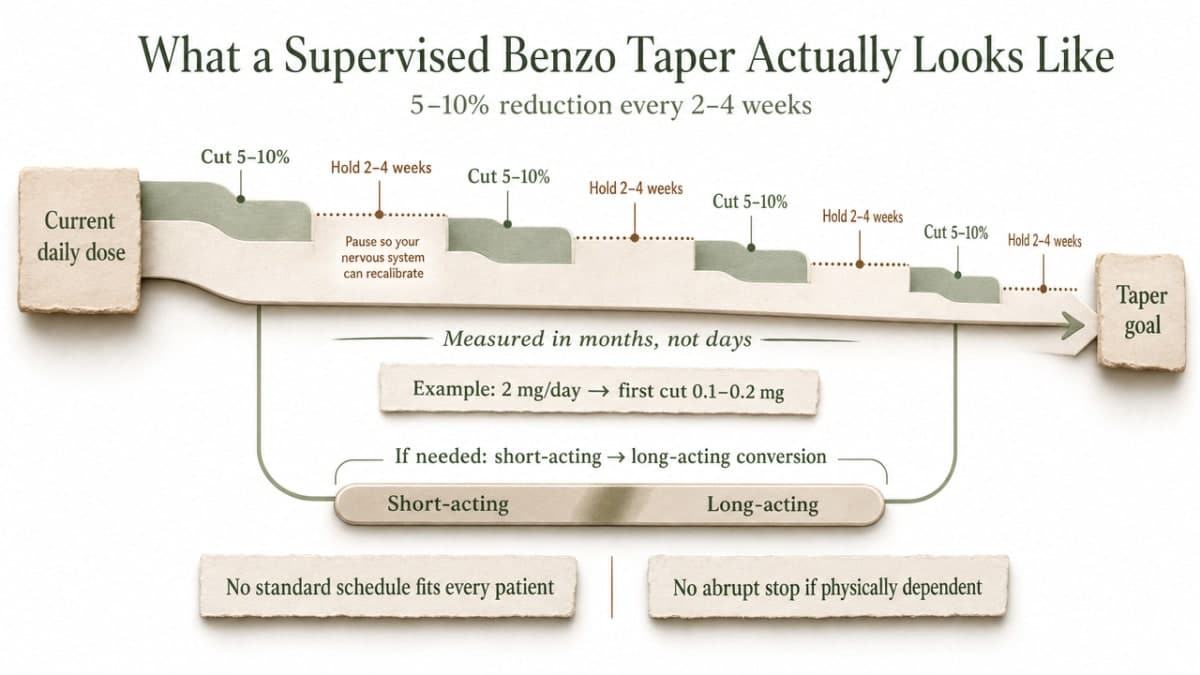
Here’s the piece that surprises most people who walk into treatment: a real benzodiazepine taper is measured in months, not days. The 2025 Joint Clinical Practice Guideline on benzodiazepine tapering, developed by ASAM and partner organizations, recommends gradual dose reductions in the range of 5–10% every 2 to 4 weeks, with no standard schedule that fits every patient and no abrupt stops in anyone likely to be physically dependent 1.
Read that again. Five to ten percent. Every two to four weeks. If you’re taking 2 mg of Klonopin a day, the first cut might be 0.1 to 0.2 mg. Small. Deliberate. Then you hold at that new dose for two to four weeks before the next reduction, so your nervous system has time to recalibrate at each step.
Why so slow? Because your brain has been operating with benzodiazepines in the system for weeks, months, or years, and the receptors that used to calm you down on their own have quieted. Pull the drug too fast and those receptors can’t catch up. That’s when the dangerous symptoms show up: rebound anxiety that feels worse than anything you’ve ever felt, insomnia that lasts days, tremors, and, at the sharp end, seizures.
You may look at that timeline and feel discouraged. Months of gradual reduction, when you wanted to be done last week. That reaction is normal, and a good medical team will hear you out on it. The pace protects you. It also protects the work you’re doing in therapy, because you can’t process trauma or practice new coping skills if your body is in acute withdrawal every seven days.
The ASAM guideline is clear that any plan has to be built for you specifically, factoring in your dose, how long you’ve been on the drug, which benzo you take, and what else is going on in your life and health 1. The 5–10% figure is a starting frame. Sunflower’s medical team uses it as a floor to build from, not a script to force you into.
Switching Short-Acting to Long-Acting: The Xanax-to-Diazepam Bridge
If Xanax is the drug you take, a supervised taper usually doesn’t taper Xanax directly. It swaps you first.
Xanax (alprazolam) and Ativan (lorazepam) are short-acting. They hit fast and leave fast, which is part of why they work for panic attacks and part of why they’re so hard to come off. Between doses, blood levels drop, and mini-withdrawal starts before your next pill. That rollercoaster is exhausting on a steady dose, and it becomes unmanageable when you start cutting the amount.
The clinical playbook is to convert you to a long-acting benzodiazepine, usually diazepam (Valium), which stays in the body far longer and produces a smoother, flatter blood level 4. Instead of peaks and troughs, you get a steady baseline. From that steady baseline, the actual dose reduction becomes tolerable.
A short course of use (four weeks or less) may allow a faster taper, while longer use calls for a slower one 4. If you’ve been on Klonopin for years, don’t expect the same schedule as someone who’s been on it for a month. That isn’t a moral judgment on your history. It’s how your nervous system works.
The swap itself needs medical supervision. Getting the equivalent dose right, timing the crossover, and adjusting for how your body responds are not things to guess at from an online conversion chart. This is one of the specific reasons Sunflower’s medical team exists for benzo detox—the switch and the taper are one continuous decision, not two.
Medically Monitored Detox vs. Cold Turkey vs. Outpatient Taper
Three paths sit in front of you. Only one of them is safe for most people with real physical dependence.
Cold turkey at home. This is the option to rule out first. Abruptly stopping benzodiazepines in someone who’s physically dependent can trigger seizures and severe complications, which is why the WHO withdrawal guideline calls gradual, supervised reduction the safest approach and recommends monitoring patients in active withdrawal every three to four hours 2. A bedroom, a partner checking on you at night, and a phone next to the bed do not clear that bar.
Outpatient taper. If your dose is modest, your use has been shorter, you don’t have a heavy co-occurring mental health load, and you have stable housing plus a clinician who can see you regularly, an outpatient taper with a prescribing provider can work. It’s not a lesser choice for the right person. It just isn’t the right choice if the picture is more complicated than that.
Medically monitored residential detox. Under Kansas Administrative Regulations § 26-52-17, crisis intervention centers offering substance use services must base their care on ASAM criteria—specifically level 3.7 (medically monitored intensive inpatient) or 4.0 (medically managed intensive inpatient) when the situation calls for it. That regulation requires facilities to“provide care to patients whose withdrawal signs and symptoms are sufficiently severe to require primary medical and nursing care services”9. In plain terms: 24-hour nursing, physician oversight, medication adjustments in real time, and a room where somebody notices if you stop looking okay.
Before you decide which path fits you, call Sunflower’s medical team. They can help you figure out which level of care matches what your body and history actually need, not just what feels less disruptive.
The Anxiety Trap: Why Trauma-Informed Dual Diagnosis Matters for Benzo Users
Here’s the cruel loop most benzodiazepine users know intimately: the drug was prescribed for anxiety, panic, or sleep problems tied to something you couldn’t shake. Then, months or years in, the withdrawal symptoms show up looking exactly like the problem you were treating in the first place. Racing heart. Chest tightness. That specific 3 a.m. dread. Your body reads reduction as danger, and the drug that used to answer the alarm is the one being taken away.
If you’ve tried to taper before and turned back at that point, you weren’t weak. You were caught in a feedback loop no medication chart alone can solve.
This is why the current clinical thinking treats a benzodiazepine taper as a psychological event, not just a pharmacological one. The 2025 guidance on supporting patients through benzodiazepine tapering emphasizes shared decision-making, trauma-informed care, validation of patient fears, and pacing that flexes with what the person in front of you can actually tolerate 5. The taper only holds when the underlying anxiety, panic, or trauma has somewhere else to go.
For a lot of benzo users, that underlying layer is trauma. PTSD. Childhood adversity that never got named. A grief the pills were quieter than. When you reduce the medication, that material comes up—not as a metaphor, as a physical experience. Without therapy running alongside the medical taper, most people reach for the dose again to make it stop. That’s not relapse in the moral sense. That’s biology asking a question the taper alone can’t answer.
Dual diagnosis care means the anxiety, the trauma, and the dependence are treated as one situation by one team, in the same building, on the same day. Not a taper here and a therapist across town you see every other Tuesday. Sunflower Recovery Center’s clinical approach is built around this specifically: identifying the trauma, depression, or anxiety underneath the substance use and treating them together, with customized plans developed by a multidisciplinary team.
Two practical things follow from this. First, a good program will slow the taper down when your psychological load is high—during a hard therapy week, after a family session that opened something up, during a wave of insomnia—rather than push through on schedule 5. Second, you should not have to explain your trauma history five different times to five different staff members. If a program isn’t set up to hold both sides of your situation, the taper it offers you is only half a plan.
Call Sunflower’s medical team before you try to reduce your dose again. Ask them, directly, how their taper protocol changes when trauma symptoms flare. The answer to that question tells you whether you’re getting a real dual diagnosis program or a detox with a therapy add-on.
What Kansas Law Requires of a Real Detox Program
When you’re deciding where to detox, the marketing language on treatment websites can sound identical from one facility to the next. “Medically supervised.” “24/7 care.” “Safe withdrawal.” Kansas law actually defines what those phrases have to mean, and knowing the definitions helps you ask better questions.
Under Kansas Administrative Regulations § 26-52-17, facilities providing acute detoxification and substance use services must base their care on American Society of Addiction Medicine (ASAM) criteria—specifically ASAM 3.7 “medically monitored intensive inpatient” or ASAM 4.0 “medically managed intensive inpatient” when withdrawal severity calls for that level 9. Those aren’t marketing labels. They’re regulatory categories with staffing, monitoring, and physician-oversight requirements attached. The same regulation requires facilities to“provide care to patients whose withdrawal signs and symptoms are sufficiently severe to require primary medical and nursing care services”9. For benzodiazepine withdrawal, that language matters, because seizure risk is exactly the kind of complication that requires nursing eyes on you, not a phone number to call after hours.
Kansas statute defines “treatment” itself broadly, covering the emergency, outpatient, intermediate, and inpatient services a licensed facility can offer 10. Licensing standards for private hospitals and mental health facilities—including standards for medication supervision—flow from a separate statute that authorizes the state to inspect, license, and, when necessary, pull the license of facilities that don’t meet the bar 11. That’s the framework behind every legitimate detox operating in this state.
What this means for you, practically: when you call a program, you can ask directly whether their detox meets ASAM 3.7 or 4.0 criteria under Kansas regulation. You can ask what the nurse-to-patient ratio looks like overnight. You can ask which physician is on call when your dose gets adjusted at 2 a.m. A program that treats those questions as reasonable is one built for real benzodiazepine withdrawal. A program that hedges is telling you something you need to hear.
Sunflower Recovery Center operates within this Kansas framework, with a medical team equipped to handle the monitoring benzo withdrawal actually requires. If you’re weighing your options, calling and asking these specific questions is a fair way to sort real capacity from a brochure.
After Detox: Residential, PHP, and IOP as One Continuous Arc
Detox is the entry point, not the destination. That distinction matters more with benzodiazepines than with almost any other substance, because the taper itself often stretches across weeks and months while the psychological work underneath it is just getting started.
Think of the recovery arc as three connected stages that flex to what you actually need. Residential care is where the medical taper begins and the trauma work opens up, with 24-hour staffing and a structured day that removes the decisions you shouldn’t have to make in early withdrawal. Sunflower’s 60-day residential program is built for this length of stay on purpose—a real benzodiazepine reduction doesn’t fit inside a two-week detox window, and the guidance on supporting patients through tapering is explicit that pacing should flex around what the person can tolerate, not a fixed calendar 5.
Partial Hospitalization (PHP) is the next step down. You’re still in treatment most of the day, still seeing the medical team, still doing therapy, but you’re sleeping somewhere less clinical. The taper often continues here. For anyone whose use exceeded four weeks, the deprescribing evidence points toward a slower reduction, which means the medical piece of your care may well extend past the residential phase 3.
Intensive Outpatient (IOP) is where you rebuild the ordinary week—work, family, appointments—while keeping several hours of clinical contact each week. By this point, the taper is usually complete or close to it, and the focus shifts to the anxiety, trauma, and coping skills that have to hold once the medication is gone.
The point of moving through all three is that the taper doesn’t hold in isolation. It holds because the same team knows your history at every step, and because nothing about your care resets when you change levels. That continuity is what a supervised benzodiazepine recovery actually looks like.
If You’re Also Using Opioids or Alcohol: The Polysubstance Question
If benzodiazepines aren’t the only thing in your system, the taper conversation gets more serious, not less. Most Kansas overdose deaths involving benzos didn’t involve benzos alone. They involved a second depressant—usually an opioid, sometimes alcohol—stacked on top. All three slow your breathing. Together, they can stop it.
Kansas Medicaid’s own prior authorization criteria for opioid use disorder medications state plainly that patients must not be prescribed benzodiazepines concurrently 12. That policy exists because the combination is dangerous enough to have shaped state-level prescribing rules. If you’re already using both, you’re not a policy failure—you’re exactly the person these regulations were written to protect, and you need a clinical team that can hold both problems at once instead of forcing you to pick which to address first.
Order of operations matters here. The clinical review on tapering is direct: when patients are on benzodiazepines and opioids together, taper the opioids first to avoid provoking the anxiety that a benzo reduction can trigger 4. That sequencing isn’t obvious from the outside, and it’s not something to work out on your own kitchen table. Alcohol adds a third variable, since alcohol withdrawal can itself produce seizures, and stacking two seizure-risk withdrawals is not a home project.
This is the version of your situation where medically monitored residential detox stops being one option among several. Call Sunflower’s medical team before you cut anything.
How to Take the Next Step in Kansas
If you’ve read this far, you already know more about benzodiazepine withdrawal than most people who try to quit alone. Here’s what to do with that.
Before you cut your dose, skip a dose, or stop refilling your prescription, call Sunflower Recovery Center’s medical team. That call is not a commitment to admit. It’s a clinical conversation about your dose, how long you’ve been on Xanax, Ativan, or Klonopin, what else you’re using, and what your history with anxiety or trauma looks like. From there, the team can tell you whether an outpatient taper is reasonable for your picture, or whether medically monitored residential care is the level Kansas regulation was built to provide for someone in your situation 9.
If you’re not ready to call a treatment center yet, the Kansas Substance Use Disorder Hotline is available 24/7 at 866-645-8216 7. It’s a state-run line, staffed around the clock, and it exists for exactly this moment.
One more thing. If you’re the spouse, parent, or adult child reading this on someone else’s behalf, you can make the first call. Sunflower’s team will talk with family members about how to approach the conversation and what a safe next step looks like. You don’t have to have the perfect words ready. You just have to pick up the phone before the next dose reduction happens on a kitchen counter instead of in a monitored room.
Start safe, medically supervised benzo detox today
Connect directly with a medical team for safe, expert-guided benzodiazepine withdrawal support right away.
Frequently Asked Questions
Is it really dangerous to stop taking Xanax or Klonopin on my own?
Yes. Benzodiazepine withdrawal is one of the few withdrawals that can trigger seizures and severe complications when the drug is stopped abruptly in someone who’s physically dependent 2. That’s why the 2025 ASAM guideline is direct that clinicians should not discontinue benzodiazepines abruptly in patients likely to be dependent 1. Call a medical team before you cut your dose.
How long does a medically supervised benzodiazepine taper take?
It’s measured in months, not days. The 2025 ASAM guideline recommends gradual reductions in the range of 5–10% every 2 to 4 weeks, individualized to your dose, drug, and history 1. If you’ve used benzodiazepines for more than four weeks, the deprescribing evidence points toward a slower taper rather than a fast one 3. Longer use generally means a longer, gentler schedule.
What’s the difference between medically monitored detox and an outpatient taper?
Monitoring frequency and staffing. Under Kansas Administrative Regulations § 26-52-17, medically monitored detox is based on ASAM 3.7 or 4.0 criteria, with 24-hour nursing and primary medical care for withdrawal severe enough to require it 9. WHO guidance says patients in active benzodiazepine withdrawal should be checked every 3 to 4 hours 2. An outpatient taper is check-ins every week or two—safer only for a milder picture.
I was prescribed benzos for anxiety or PTSD. Will those symptoms come back during withdrawal?
Often, yes—and they can feel more intense than what you started with. Current guidance on supporting patients through tapering treats this as expected, not as failure, and calls for trauma-informed care, validation, and pacing that flexes with what you can tolerate 5. A dual diagnosis program treats the anxiety, trauma, and dependence as one situation, so the taper isn’t asking you to white-knuckle your way through returning symptoms alone.
What happens after detox is finished?
Detox is the entry point. For most benzodiazepine users, the taper continues into residential care, then into a Partial Hospitalization Program, then into an Intensive Outpatient Program as you rebuild an ordinary week. The taper pace should flex with what you can tolerate psychologically, not a fixed calendar 5. If your use exceeded four weeks, expect the medical piece to extend past the residential phase 3.
What if I’m using benzodiazepines along with opioids or alcohol?
That combination is more dangerous, and it changes the taper plan. Kansas Medicaid’s own opioid use disorder criteria state that patients must not be prescribed benzodiazepines concurrently, reflecting the overdose risk of stacking depressants 12. Clinical taper guidance says when benzos and opioids are used together, opioids are typically tapered first to avoid provoking anxiety 4. This is a situation for medically monitored care—call Sunflower’s team first.
References
- Joint Clinical Practice Guideline on Benzodiazepine Tapering. https://pmc.ncbi.nlm.nih.gov/articles/PMC12463801/
- Clinical Guidelines for Withdrawal Management and Treatment of Drug Dependence in Closed Settings. https://www.ncbi.nlm.nih.gov/books/NBK310652/
- Deprescribing benzodiazepine receptor agonists: Evidence-based clinical practice guideline. https://pubmed.ncbi.nlm.nih.gov/29760253/
- Clinical Review: Recommendations for the Tapering of Benzodiazepines. https://medi-calrx.dhcs.ca.gov/cms/medicalrx/static-assets/documents/provider/dur/educational-articles/dured_31028_Clinical_Review_Recommendations_for_the_Tapering_of_Benzodiazepines.pdf
- Supporting Patients Through Benzodiazepine Tapering. https://pmc.ncbi.nlm.nih.gov/articles/PMC12463782/
- Drug Overdose Deaths in Kansas 2020–2024. https://www.kdhe.ks.gov/DocumentCenter/View/55471/2020-2024-Kansas-Overdose-Deaths-PDF
- Overdose Data Dashboard | KDHE, KS. https://www.kdhe.ks.gov/1309/Data-Dashboard
- Suspected Overdose ED Visits in Kansas – Fact Sheet. https://www.kdhe.ks.gov/DocumentCenter/View/56984/2026-KDHE-Overdose-ED-Visit-Fact-Sheet-PDF
- Kan. Admin. Regs. § 26-52-17 – Alcohol and substance abuse services. https://www.law.cornell.edu/regulations/kansas/K-A-R-26-52-17
- Kansas Statutes 59-29b-46 – Definitions related to treatment facilities. https://www.kslegislature.gov/b2025_26/laws/059_000_0000_chapter/059_029b_0000_article/059_029b_0046_section/059_029b_0046_k/
- Kansas Statute 75-3307b – Licensing and standards for facilities. https://www.kslegislature.gov/li_2012/b2011_12/statute/075_000_0000_chapter/075_033_0000_article/075_033_0007b_section/075_033_0007b_k/
- Opioid Use Disorder Agents – Prior Authorization Criteria (April 2023). https://www.kdhe.ks.gov/DocumentCenter/View/28639/Opioid-Use-Disorder-Agents–April-2023-PDF