
Key Takeaways
- Co-ed rehab in the Kansas City metro means mixed-gender programming with separated sleeping quarters, strict rules on client relationships, and individual therapy reserved for deeper trauma work.
- Research shows most adults do about equally well in co-ed and single-gender care when the program is evidence-based, though women with high psychiatric symptom severity may benefit from single-gender groups 8, 12.
- Distance and access shape the decision: Sunflower’s Osawatomie location sits roughly an hour to 90 minutes from Overland Park, Olathe, downtown KC, and the Northland via I-35, close enough for family involvement.
- Before admitting, compare trauma-informed facilitation, whether women-focused or men-focused groups are embedded inside the co-ed structure 15, insurance acceptance, and the recommended level of care for your situation.
Reading this at 2 a.m. in Overland Park or the Northland
If you are reading this in the quiet part of the night, phone light on your face, trying to figure out whether a co-ed rehab is the right call for you or someone you love, take a breath. You are already doing the harder thing. Most people never open the tab.
You have probably scrolled through a handful of facility pages by now. Some of them sold you on “real-world environments.” Others sold you on “safe, women-only spaces” or “men’s programs built for accountability.” The pages sound confident. Your situation feels anything but.
Here is what this article is going to do, honestly. It will walk you through what co-ed treatment actually looks like day to day, what the research says about how it compares to gender-specific care, who tends to do well in a mixed-gender program, and where a men-only or women-only setting may serve better. It will name the honest limitations of co-ed groups too, because pretending they do not exist would insult you.
You live in Overland Park, Olathe, Lenexa, downtown KC, Independence, or somewhere up in the Northland. Sunflower Recovery Center sits about an hour south in Osawatomie, Kansas. That distance matters, and we will get to it. So does the fact that most adults do not need a perfect program. They need a good one that fits.
Keep reading. You are not behind.
What co-ed rehab actually looks like day to day
Picture a Tuesday. You wake up in a residential bedroom, not a hospital room. Breakfast is at a shared table. There are men and women in the room. Some are your age. Some are older. Someone is quiet because it is early. Someone else is already talking about coffee.
By mid-morning you are in group. That is the piece that scares most people about co-ed treatment, so it is worth being specific. A clinician runs the room. The topic might be craving triggers, or a skill from cognitive behavioral therapy, or how to sit with a hard feeling without reaching for a substance. People take turns. You do not have to share on day one. You listen.
Later there is individual therapy, one-on-one, private. That is where the harder trauma work usually happens, not in the mixed group. Between sessions there may be a fitness block, a family call, a meeting with the psychiatrist about your medication, or a quiet hour on the unit.
Meals are shared. Downtime is shared. The friendships that form across gender in a co-ed setting sometimes end up being the first non-using, non-romantic relationships a person has had in years. That is not a small thing.
A few realities worth naming. Sleeping quarters are separated. Bathrooms are separated. Program rules about relationships between clients are strict, and clinicians enforce them because early recovery is not the season for new romance. Structure is not a suggestion.
If any of this sounds more ordinary than what the marketing pages promised, good. Ordinary is what recovery is built on.
What the research says about co-ed vs. single-gender outcomes
Here is the part where the marketing pages start to fall apart. Because when you look at the actual studies, not the sales copy, the picture is more honest and more useful than either side wants it to be.
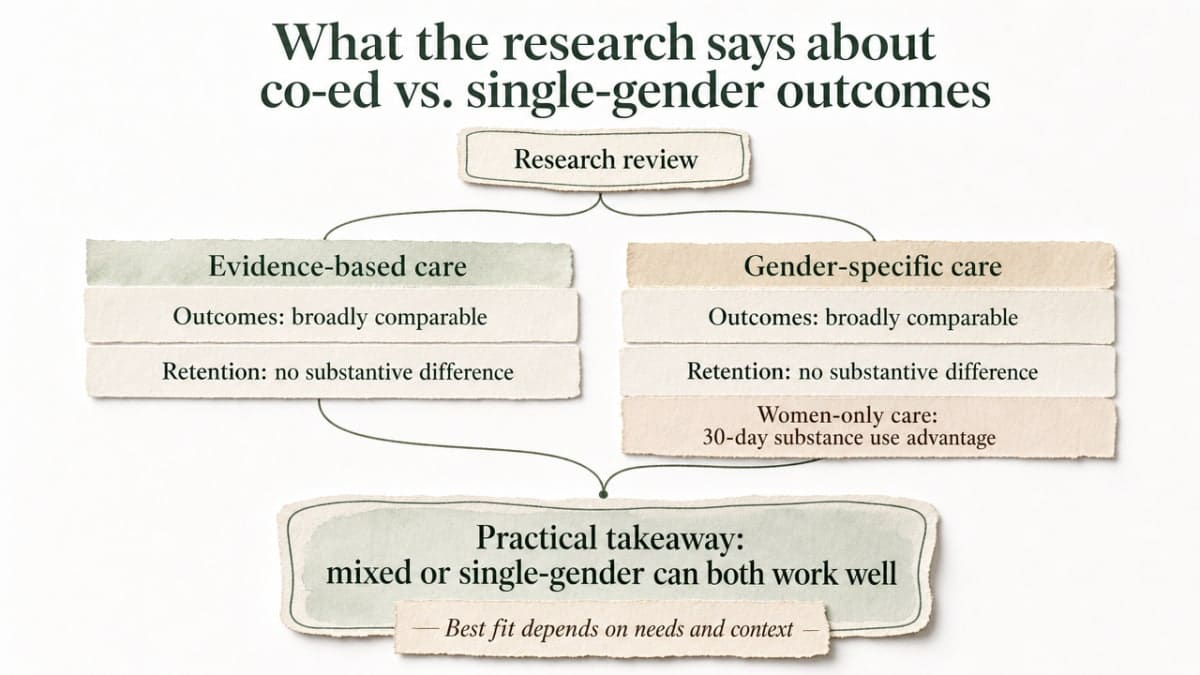
Start with the big-picture finding. A NIH-linked review of the evidence on sex and gender in substance use disorder treatment concluded that men and women generally do not differ substantively in outcomes or retention when they get evidence-based care 12. Read that sentence twice. The average adult walking into a well-run program tends to do about as well regardless of whether the room is mixed or single-gender.
A separate review of gender and treatment use reached the same practical conclusion: limited evidence suggests gender-specific treatment is not generally more effective than mixed-gender treatment, and for a large share of men and women, co-ed settings will likely be more cost-effective than building parallel systems 10.
Now the nuance, because you deserve it.
When researchers zoom in on specific outcomes for women, a few differences show up. One propensity-score-adjusted study found that women in women-only programs were about two and one-third times less likely to report any substance use in the 30 days before their 12-month follow-up compared to women in mixed-gender programs 11. That is a real finding, and it is worth naming.
But the same body of research shows the advantage is uneven. In an outpatient comparison of 152 women in women-only care and 139 in mixed-gender care, the women-only group reported less substance use and less criminal activity at follow-up, and yet arrests and employment outcomes were the same 2. Both groups improved. The difference lived in some columns, not others.
The Kansas City picture: demand, drive time, and access
Zoom out for a minute. The reason this decision feels crowded is that a lot of people around you are making it too, even if nobody talks about it at the school pickup line or the office.
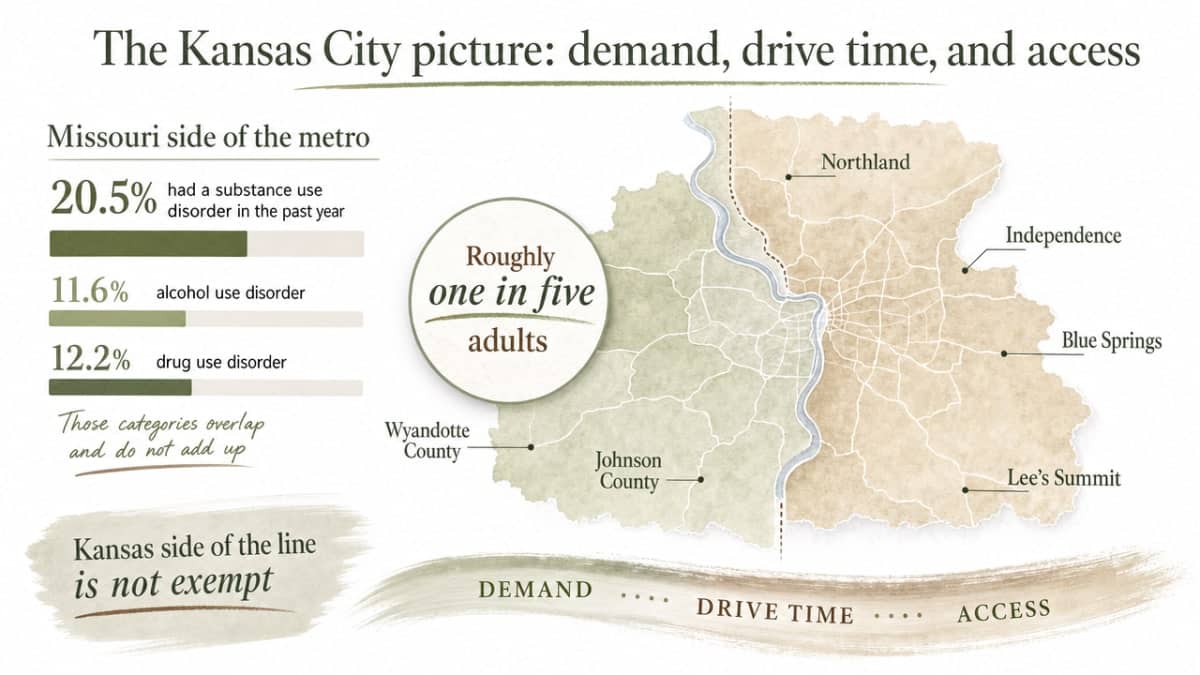
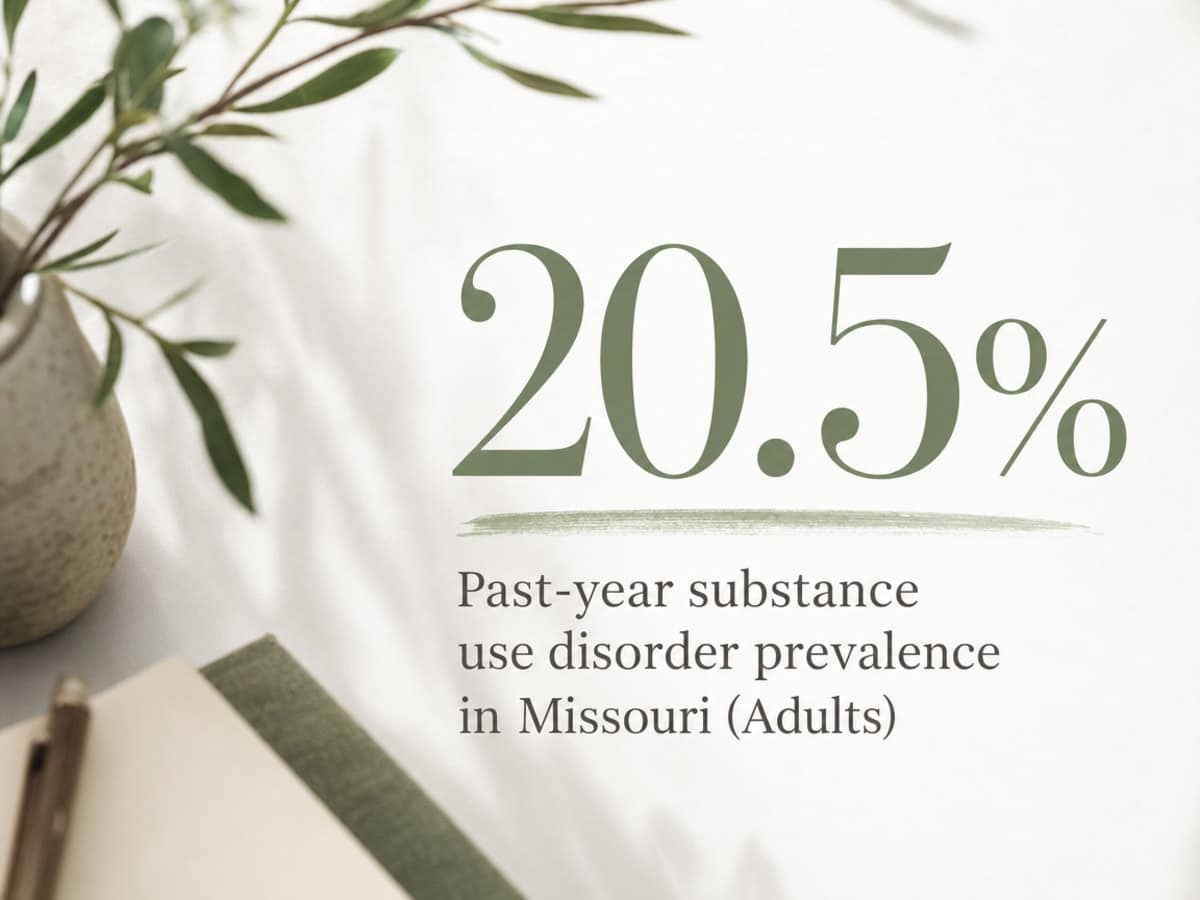
On the Missouri side of the metro, the numbers are sobering. The state’s 2025 behavioral health data report estimates that 20.5% of Missouri adults had a substance use disorder in the past year, with 11.6% meeting criteria for an alcohol use disorder and 12.2% for a drug use disorder 9. Those categories overlap, so they do not simply add up. What they tell you is that roughly one in five adults across places like Independence, the Northland, Blue Springs, and Lee’s Summit is living with something you are also living with. You are not the strange one in the room.
The Kansas side of the line is not exempt. Johnson County, Wyandotte County, and the neighborhoods spilling out from downtown all feed the same regional treatment demand. Beds fill up. Waitlists happen. When a program only accepts one gender, half the potential clients in a given week cannot use that bed. Co-ed programs exist in part because they can meet the actual scale of the problem without carving the population in half.
Then there is the drive. Sunflower Recovery Center sits in Osawatomie, about an hour south of Overland Park on a good traffic day, closer to 75 minutes from Olathe or Lenexa, and roughly 90 minutes from downtown KC or the Northland depending on where you cross the river. For a residential stay, that distance is a feature, not a bug. Far enough from your usual triggers to interrupt the pattern. Close enough that family can visit on a Sunday without booking a flight.
If you are helping someone else make this call, the drive matters for another reason: family programming works better when the people who love the person can actually show up. I-35 south from Johnson County is a straight shot. That is not nothing when you are trying to keep a spouse or a parent involved in recovery.
Who tends to do well in a co-ed program
Instead of asking which program type is better in the abstract, ask a more useful question: which one fits the person you actually are right now?
A well-run co-ed program tends to work well for adults whose primary struggle is the substance itself, plus the ordinary human stuff around it — job stress, a marriage under strain, grief, sleep that fell apart, a slow slide into daily drinking that finally caught up. If you can sit in a room with men and women and speak honestly about a hard week without feeling unsafe, co-ed care will likely serve you.
It also tends to fit people who are heading back into a mixed world. You do not live in a men-only office or a women-only neighborhood. You live on your block, in your family, in your workplace. Practicing recovery skills with the same range of people you will meet on Monday morning is not a marketing line. It is repetition where it counts.
Co-ed groups often serve well when your social circle collapsed around your using and you need to relearn how to have a plain, non-transactional conversation with another adult. The mixed room, run by a skilled clinician, becomes practice ground.
Here is the clinical piece worth naming plainly. The modern consensus is that gender itself is not a strong predictor of who does well in treatment; what predicts outcomes is whether the program addresses your specific needs — trauma history, co-occurring depression or anxiety, family situation, medical complexity 5. A trauma-informed co-ed program that takes those needs seriously will outperform a gender-specific program that treats you like a diagnosis.
Four honest questions can help you sort your own situation:
- How heavy is your trauma load, and how much of it is tied to the opposite sex?
- How high are your current psychiatric symptoms — panic that stops you mid-sentence, depression that keeps you in bed, PTSD symptoms that flare in groups?
- How comfortable are you speaking honestly in a mixed room?
- Have you experienced gender-based harm that is still raw?
The research is specific on that middle question. For women with high psychiatric symptom severity, single-gender group treatment may add benefit beyond what a mixed-gender group provides 8. That is not a rule for every woman. It is a signal for a subset. If your answers to those four questions land in the ordinary-to-moderate range, a co-ed program with strong clinical facilitation is a reasonable, evidence-supported choice. If your answers cluster at the severe end, that is a conversation to have out loud with a clinician before you admit anywhere.
Where single-gender care may serve better
Being honest about what co-ed care does well means being just as honest about where it may not be the right first step.
If you are a woman carrying high current psychiatric symptoms alongside your substance use — think panic attacks that shut you down, depression that makes it hard to sit up in a group, or PTSD that flares when men are in the room — the research points somewhere specific. A study looking at whether baseline symptom severity changes what kind of group works best found that single-gender group treatment may add real benefit for women with substance use and high psychiatric symptom severity, above what mixed-gender groups provide 8. That is a narrow, useful finding. It is not a rule for every woman. It is a signal for a specific subset.
Trauma history that is tightly bound to the opposite sex is the other honest reason to consider a women-only or men-only setting first. If most of the harm you have survived came from men, sharing a first-week group with men — even a well-run one — can pull your nervous system out of the room. You can eventually do that work. You may not want to do it on day three.
There is also a longer-term finding worth naming. A randomized trial of a women-focused group compared to a mixed-gender group found the two were about equally effective during treatment, but the women-focused group showed continued improvement in substance use outcomes six months after treatment ended 7. For some women, that sustained trajectory is the deciding factor.
None of this argues against co-ed care for the majority of adults. It argues for matching the room to the person. If any of the above describes you, say so plainly on the admissions call. A clinician can help you decide whether to start in a women-focused track, a men-only program, or a co-ed setting that embeds women-focused groups inside it — which is a real option and often the practical middle path.
The honest limitation of co-ed groups, and what trauma-informed facilitation does about it
Here is the part most facility pages skip. There is a real, documented limitation to mixed-gender group work, and pretending otherwise would be doing you a disservice.
Earlier clinical research on group process found that mixed-gender groups tend to expand the range of interpersonal styles men show up with, while at the same time constraining how much women vary their style. Women in that study showed a wider range of expression in single-gender groups than in mixed ones 4. In plain language: put some women in a co-ed room and they get a little smaller. They edit. They watch the men. They wait for a safer moment that may not arrive.
That is a real finding. It also is not the end of the story.
The reason it is not the end of the story is that the finding measures what happens in an ordinary mixed group, not what happens in a trauma-informed one. Those are different rooms.
Trauma-informed facilitation is a set of practical clinical habits, not a slogan. It looks like:
- A clinician who sets group agreements out loud on day one — no cross-talk, no advice-giving, no interrupting, no commenting on anyone’s body or story outside the room.
- A facilitator who watches the quieter half of the group and creates room for them to speak without spotlighting them.
- A clinician who will pause a man who is dominating the air and redirect without shaming him, because that skill is part of the job.
It also looks like structure around what group is for. Heavy trauma disclosure usually belongs in individual therapy, where you and one clinician can move at your own pace. Mixed group is typically used for skills, coping, relapse prevention, and the daily work of learning to sit with feelings without using. That separation protects everyone in the room.
There is one more piece worth naming, because it is the practical answer to the 4 concern. Women-focused groups can be embedded inside a co-ed program. You can be in mixed group Monday and Wednesday and in a women-only group Tuesday and Thursday, in the same building, with the same clinical team. Researchers who study what “women-focused” treatment actually is have made this point directly: gender composition can mean women-only programs or women’s services embedded inside mixed-gender settings, and both count as women-focused when the content addresses trauma, parenting, and mental health 15. The choice is not always either-or. Ask about it on the admissions call.
Sunflower’s co-ed model in Osawatomie
Sunflower Recovery Center runs a co-ed program in Osawatomie built around one clinical idea: what happens inside the room matters more than the mix of people in it. That framing lines up with where the research has landed. Gender-responsive content delivered inside a well-facilitated program tends to be the thing that moves outcomes, not the gender composition of the group by itself 13.
A few things about the model are worth naming directly.
The clinical center of gravity is trauma-informed dual diagnosis care. That means the program starts from the assumption that the substance use sitting on top is usually the visible part of something older underneath — depression, anxiety, PTSD, an eating disorder, grief that never got worked through. Individual therapy is where the deeper trauma work happens. Mixed group is used for skills, coping, and the daily rehearsal of recovery, which is what the group literature actually supports.
The continuum runs from a 60-day residential stay through a Partial Hospitalization Program and into an Intensive Outpatient Program. That matters for a co-ed model because the intensity steps down as your stability grows. You are not dropped into a mixed room on your worst day and expected to perform.
Sunflower’s approach also fits the practical middle path the research keeps pointing to: women-focused care can be embedded inside a mixed-gender setting when the content addresses trauma, parenting, and mental health 15. Ask the admissions team what that looks like in your case. It is a real conversation, not a script.
Practical logistics: insurance, admissions, and the drive south on I-35
The clinical fit question is the big one, but the logistical questions are the ones that actually stall people at the front door. So here they are, plainly.
Insurance first. Sunflower accepts most commercial insurance plans. The admissions team can verify your benefits on the phone in a single call, usually while you are still on the line. What Sunflower does not participate in is Medicare or Medicaid. If those are your coverage, the admissions team can point you toward programs in the region that do.
Admissions is a conversation, not a form. You call, you talk with someone about what is going on, they ask about substances, medical history, mental health, and current stability, and they help you figure out whether residential, PHP, or IOP is the right level of care to start at. If you need a medical detox first, they will tell you.
The drive is I-35 south to Osawatomie. From Overland Park, about an hour. From downtown KC or Independence, plan on 75 to 90 minutes. Pack light. You will be told what to bring.
How to make the call and what to ask
When you are ready, the call itself is short. Fifteen or twenty minutes on the phone with someone who does this every day. You do not need a script. You do need a few questions.
Ask what a typical day in the co-ed program looks like, and how mixed group is facilitated. Ask how the clinicians handle trauma disclosures — specifically, what stays in individual therapy and what happens in group. Ask whether women-focused or men-focused groups are embedded inside the co-ed structure, since that middle path is a real option 15. Ask what the program does when someone in group starts dominating the room.
Then ask the practical ones:
- What level of care do you recommend for me based on what I just told you?
- What does my insurance actually cover?
- When is the next available bed?
If a co-ed program in the KC area is what you are weighing, call Sunflower Recovery Center in Osawatomie and ask a clinician whether their trauma-informed model fits your situation. That is the conversation worth having.
Connect with a Team That Understands Recovery
Start building your personalized, trauma-informed treatment plan with professionals who support your journey every step.
Frequently Asked Questions
Will I have to share group therapy with the opposite sex if I’ve been through gender-based harm?
Not necessarily, and this is worth saying out loud on the admissions call. Heavy trauma work usually happens in individual therapy, not mixed group. Many co-ed programs also embed women-focused or men-focused groups inside the co-ed structure, which the research recognizes as a legitimate form of gender-responsive care 15. Tell a clinician what you have survived. They can help you sequence it.
Is a co-ed program less safe or less effective than a men-only or women-only rehab?
No. The broad research finding is that men and women do not substantively differ in outcomes when they get evidence-based SUD care, and gender-specific treatment is not generally more effective than mixed-gender treatment for most adults 12, 10. Safety comes from trauma-informed facilitation, clear group agreements, and separated sleeping quarters. A well-run co-ed program has all three. A poorly run single-gender program has none.
How do I know if I’d do better in single-gender care instead?
Look at four things honestly: your trauma load, your current psychiatric symptoms, your comfort speaking in mixed rooms, and whether past harm was tied to the opposite sex. For women with high psychiatric symptom severity, single-gender group treatment may add real benefit beyond what mixed groups offer 8. If your answers cluster at the severe end, say that to a clinician before you admit anywhere.
Are men and women housed together at Sunflower’s Osawatomie facility?
No. Sleeping quarters and bathrooms are separated by gender. Programming, meals, and most therapy groups are co-ed, but the living space is not. Program rules also prohibit romantic contact between clients during treatment, and clinicians enforce them. Early recovery is not the season for new relationships, and the structure exists to protect the work you came to do.
How long is the drive from Overland Park, Olathe, or the Northland to Osawatomie?
From Overland Park, plan on about an hour down I-35. From Olathe or Lenexa, closer to 75 minutes. From downtown KC, Independence, or the Northland, budget 75 to 90 minutes depending on traffic and where you cross the river. Far enough from your usual triggers to interrupt the pattern. Close enough that family can visit on a Sunday.
What if I call and I’m not sure co-ed is right for me?
Then say exactly that. The admissions call is a conversation, not a commitment. A clinician can walk through your situation, ask about trauma, mental health, and current stability, and tell you honestly whether Sunflower’s co-ed model fits or whether a different setting would serve you better. You are allowed to ask questions, hang up, think about it, and call back. That is normal.
References
- Women-only and mixed-gender drug abuse treatment programs: service needs, utilization and outcomes. https://pubmed.ncbi.nlm.nih.gov/16996232/
- The relative effectiveness of women-only and mixed-gender treatment for substance-abusing women. https://pubmed.ncbi.nlm.nih.gov/21315540/
- Women’s programs versus mixed-gender day treatment. https://pubmed.ncbi.nlm.nih.gov/15598193/
- Treatment of substance abusers: single or mixed gender. https://pubmed.ncbi.nlm.nih.gov/9293039/
- Gender Considerations in Addiction: Implications for Treatment. https://pmc.ncbi.nlm.nih.gov/articles/PMC4578628/
- Gender Differences in Substance Use Disorders. https://ictp.uw.edu/wp-content/uploads/2024/03/UWPACC-2022_03_31-Women-and-Addiction.pdf
- The Women’s Recovery Group Study: A Stage I trial of women-focused group therapy for substance use disorders. https://pmc.ncbi.nlm.nih.gov/articles/PMC3679366/
- High psychiatric symptom severity is a moderator of substance abuse treatment outcomes among women in single vs. mixed gender group treatment. https://pubmed.ncbi.nlm.nih.gov/18821452/
- 2025 Annual Data Report on Missouri’s Substance Use and Mental Health. https://dmh.mo.gov/sites/dmh/files/media/pdf/2026/03/2025-annual-report-part1_2.pdf
- Gender and Use of Substance Abuse Treatment Services. https://pmc.ncbi.nlm.nih.gov/articles/PMC6470905/
- The Relative Effectiveness of Women-Only and Mixed-Gender Substance Abuse Treatment. https://pmc.ncbi.nlm.nih.gov/articles/PMC3081899/
- Sex and Gender Differences in Substance Use Disorders. https://pmc.ncbi.nlm.nih.gov/articles/PMC5945349/
- Gender differences in substance use disorders: Is there a need for gender-specific treatments?. https://pmc.ncbi.nlm.nih.gov/articles/PMC4555884/
- Do women with complex alcohol and other drug use histories want women-only treatment?. https://pmc.ncbi.nlm.nih.gov/articles/PMC6221094/
- What Is “Women-Focused” Treatment for Substance Use Disorders?. https://pmc.ncbi.nlm.nih.gov/articles/PMC2753530/