
Key Takeaways
- Kansas offers all three FDA-approved opioid use disorder medications — buprenorphine, methadone, and naltrexone — across residential, PHP, IOP, office-based, and SAMHSA-certified opioid treatment program settings 1.
- The 2024 national guideline update treats buprenorphine and methadone as co-equal first-line options, with methadone showing stronger retention and buprenorphine carrying lower overdose risk after induction 3, 8.
- Kansas has adopted SAMHSA’s expanded methadone take-home flexibilities, allowing up to 7 doses in the first 14 days, 14 through day 30, and 28 after day 31 9.
- Kansas Medicaid covers all forms of buprenorphine, methadone, and naltrexone under SPA 21-0007, though Sunflower Recovery Center does not accept Medicaid and can refer callers to OTPs or OBOT clinicians that do 12.
What treatment actually looks like when you pick up the phone in Kansas
If you’re reading this at 2 a.m., or between doses, or with your kid asleep in the next room while you try to figure out what to do about your sister — you’re already doing the hard part. You’re looking.
Here’s what the ground looks like in Kansas. Opioid dependence is a medical condition with three FDA-approved medications behind it — buprenorphine, methadone, and naltrexone — and decades of evidence that these medicines save lives when paired with counseling and real support 5. You have residential programs where you sleep on-site for weeks. You have partial hospitalization and intensive outpatient programs where you go home at night. You have office-based clinicians who can write a buprenorphine prescription during a regular appointment, and SAMHSA-certified opioid treatment programs that dispense methadone 1. Kansas Medicaid covers all three medications for people who qualify 12. Kansas has also concurred with expanded methadone take-home rules, which means daily clinic visits loosen up faster than they used to 9.
None of that is a sales pitch. It’s the map.
When you call Sunflower Recovery Center’s 24/7 line, a person picks up. They ask what’s going on right now — are you using, are you in withdrawal, are you safe. They ask about insurance, other health conditions, and whether you’ve tried treatment before. If it makes sense to come in, they schedule an assessment. If a different level of care fits better, they’ll tell you that too.
That’s the first call. That’s all it has to be.
The medicines that do the heavy lifting
Buprenorphine, methadone, and naltrexone: what each one does
Three medicines carry most of the clinical weight in opioid use disorder care, and each one works differently on the same problem 2. Understanding them helps you have a real conversation with a doctor instead of a confused one.
- Buprenorphine
- A partial opioid agonist. In plain terms: it binds to the same receptors that heroin, fentanyl, or oxycodone bind to, but only partly. That’s enough to shut down cravings and stop withdrawal without producing the high. You’ve probably seen it as Suboxone, a small film that dissolves under your tongue, or as a monthly extended-release injection called Sublocade. A regular family doctor, psychiatric nurse practitioner, or addiction specialist can prescribe it during an office visit — you don’t need a special clinic.
- Methadone
- A full opioid agonist. It fully occupies those same receptors at a steady, long-acting dose, which keeps withdrawal and cravings quiet for around 24 hours per dose. Methadone for opioid use disorder can only be dispensed through a SAMHSA-certified opioid treatment program (OTP), which is why people sometimes call it “going to the clinic” 13. Early on, that usually means daily visits. Kansas has loosened those rules over time, which we’ll get to.
- Naltrexone
- The opposite kind of medicine — an opioid antagonist. It blocks the receptors so opioids can’t attach. It comes as a daily pill or, more commonly for opioid use disorder, as Vivitrol, a monthly injection. Because it’s a blocker, you have to be fully off opioids for roughly 7 to 10 days before your first dose, or you’ll go straight into precipitated withdrawal 4.
Counseling and psychosocial support are meant to run alongside all three 4. The medicine handles the biology. The rest of the work — trauma, sleep, relationships, why you started using in the first place — needs people.
Buprenorphine or methadone: an honest comparison
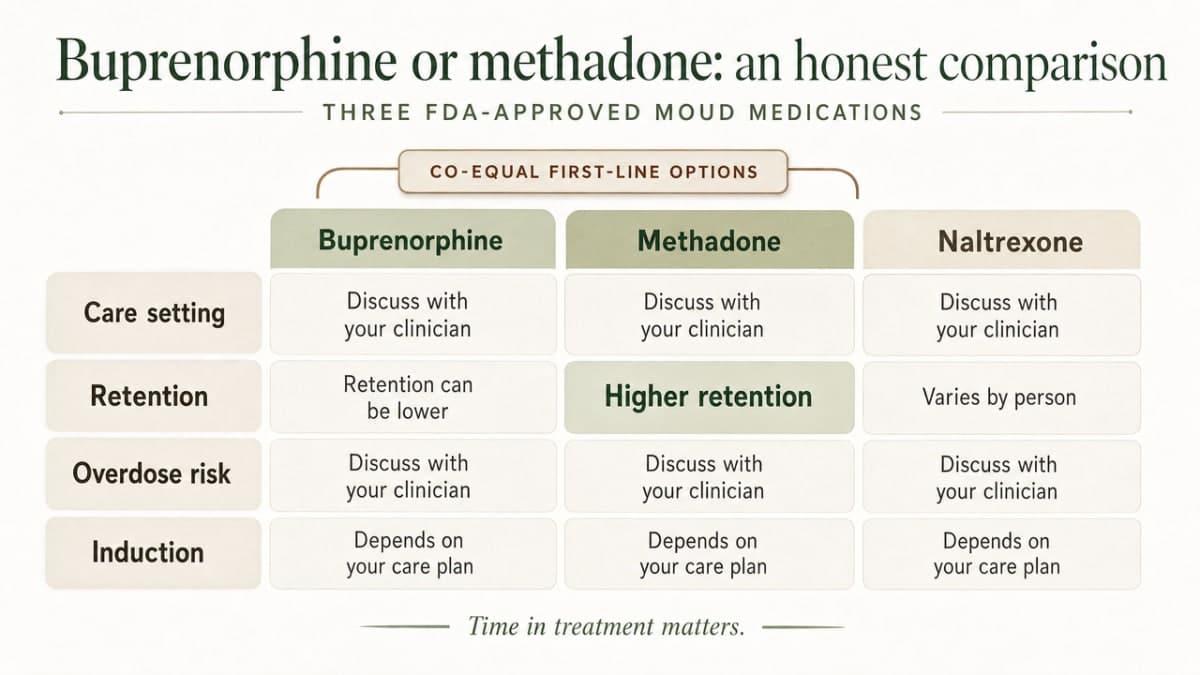
If you’re weighing your options, the real choice for most people comes down to buprenorphine versus methadone. The 2024 national clinical practice guideline update treats them as co-equal first-line treatments, not as first choice and backup 3. Both work. They just work differently, and the tradeoffs are worth knowing before you sit down with a doctor.
Retention. A systematic review comparing the two medications found methadone is associated with higher treatment retention — meaning more people stay in care longer on methadone than on buprenorphine 8. That matters, because time in treatment is one of the strongest predictors of long-term recovery. If you’ve tried buprenorphine before and drifted away from it, methadone isn’t a failure step. It’s often the sturdier scaffold.
Overdose risk. The same review found buprenorphine tends to have a lower overdose risk profile, especially once you’re through induction 8. Its partial-agonist ceiling means it’s harder to overdose on buprenorphine alone than on methadone at equivalent effect. That safety margin is one reason primary care clinicians can prescribe it in an office setting.
Where you get it. Buprenorphine is office-based. Any DEA-registered clinician with Schedule III authority can write for it, so you can start it in a doctor’s office, a behavioral health clinic, or during a residential admission 1. Methadone for OUD lives inside a certified OTP, which means dosing at a specific clinic, at least at first 13.
Induction. Buprenorphine has a catch — you have to be in mild to moderate withdrawal before your first dose, or the medicine itself will trigger sudden, severe withdrawal 4. Methadone doesn’t have that requirement; you can start it while still comfortable, and the dose is titrated upward slowly.
The oral naltrexone question. The 2024 guideline update also downgraded oral naltrexone, citing poor retention and no clear benefit over placebo in recent evidence 3. The monthly injection is a better bet if naltrexone is the right fit — usually for people who’ve already been off opioids for a stretch, like after a residential stay.
None of this decides itself on paper. A good clinician will listen to your history — how much you’ve been using, what you’ve tried, whether you can get to a daily clinic, whether you’re pregnant, what other medications you take — and help you pick. Both roads lead to the same place: less craving, fewer overdoses, more room to actually live your life 5.
Starting buprenorphine when fentanyl is in the picture
If what you’ve been using is fentanyl — or something you bought that turned out to be fentanyl — the induction rules get trickier. Fentanyl is more potent than heroin and lingers in body fat longer than older opioids, which means the window where you’re in mild-to-moderate withdrawal (and ready for that first buprenorphine dose) can arrive later and feel harder to time 7.
Two things follow from that. First, precipitated withdrawal — the sudden, punishing kind buprenorphine can trigger if you start too early — is a real risk clinicians take seriously, and one you should hear about before your first dose 4. Second, patients with heavy fentanyl exposure often need higher buprenorphine doses and adjusted induction strategies than the standard protocols assumed a decade ago 7.
The takeaway isn’t that buprenorphine won’t work for you. It’s that you need a clinician who’s induced people off fentanyl before and who will walk you through the timing carefully. Some programs use micro-dosing induction, where small amounts of buprenorphine are layered in over days instead of hours. Ask about it. If your first attempt at induction was rough, that’s information, not a verdict.
Where care happens: residential, PHP, IOP, and office-based treatment
Residential care and the first 72 hours
Residential treatment means you sleep on-site, eat there, and stay for a defined stretch — at Sunflower, that’s a 60-day program. It’s the option that pulls you out of the environment you’ve been using in and gives your body and brain a chance to settle before life starts making demands again.
Here’s what the first 72 hours can look like, so it stops being a mystery.
Day one. You arrive. Someone takes your vitals, asks about the last time you used, and works through a medical and psychiatric history — including trauma, past treatment, and any other medications. If you’re in withdrawal or heading into it, a physician or nurse practitioner assesses you for medication. Buprenorphine induction typically begins once you’re in mild-to-moderate withdrawal, which for short-acting opioids often lands somewhere in the first 12 to 24 hours; for methadone-to-buprenorphine transitions, the wait is longer 11. You’ll be checked on frequently. Sleep will be bad. That’s expected.
Day two. Symptoms usually peak — muscle aches, restlessness, nausea, the crawling-out-of-your-skin feeling. Medication doses get adjusted. You start meeting the people who’ll be part of your care: a therapist, a case manager, maybe a psychiatrist for co-occurring conditions 4.
Day three. The worst of the acute withdrawal begins to ease for most people on buprenorphine or methadone. You’re still tired. But you’re eating something. You’re in a room with other people who understand exactly where you’ve been. That’s when the real work — the trauma work, the group work, the sleep and the fitness and the slow rebuilding — can actually begin.
PHP, IOP, and stepping down without falling off
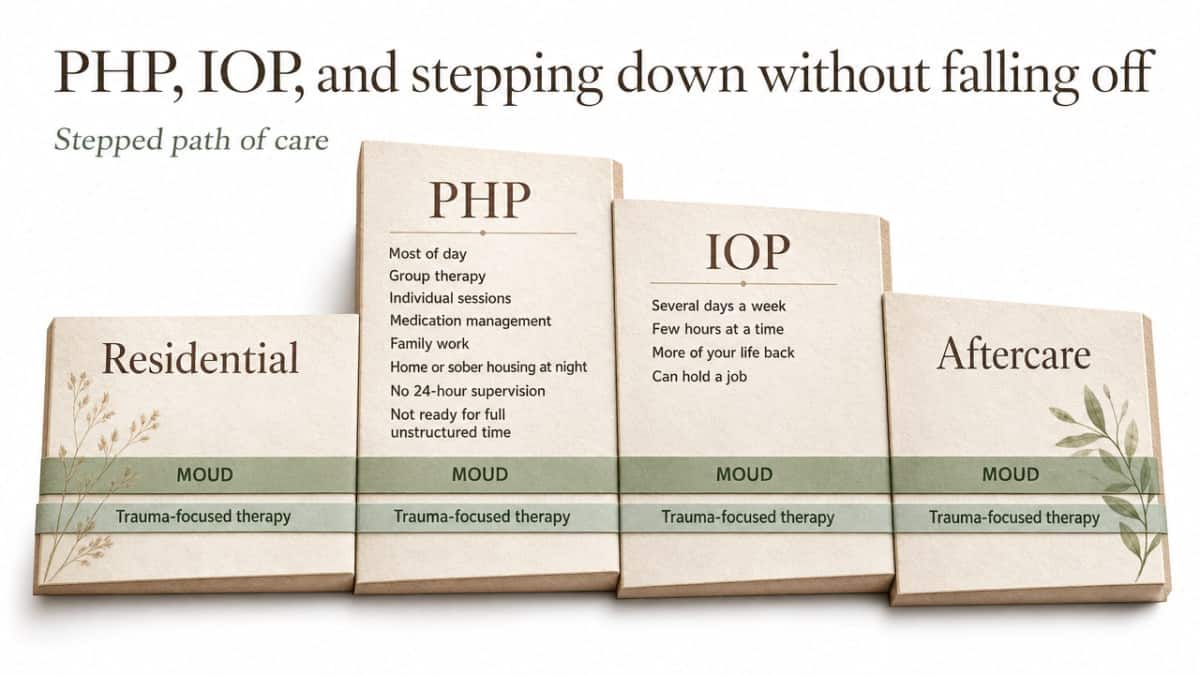
Treatment isn’t a single event you check into and check out of. It’s a stepped path, and each step is designed to hold you while giving you more of your life back.
Partial hospitalization (PHP) is the next rung down from residential. You spend most of the day in structured programming — group therapy, individual sessions, medication management, sometimes family work — and go home or to sober housing at night. It’s the level of care for someone who no longer needs 24-hour supervision but isn’t ready to be alone with a full day of unstructured time.
Intensive outpatient (IOP) steps you down further. You’re in programming several days a week for a few hours at a time, which means you can hold a job, care for kids, and sleep in your own bed while still doing serious clinical work.
Falling off usually happens at the transitions. A good program plans the handoff before you need it.
Office-based opioid treatment (OBOT) and OTPs in Kansas
Not everyone needs — or wants — a residential stay. Kansas has two other doors into care, and knowing which one you’re walking through helps.
Office-based opioid treatment (OBOT) is what it sounds like. You see a clinician in a regular office — primary care, a psychiatric practice, a behavioral health clinic — and they prescribe buprenorphine or naltrexone. Since the federal X-waiver was removed, any DEA-registered clinician with Schedule III authority can write for buprenorphine, which has widened the pool of prescribers considerably 1. You fill the prescription at a pharmacy like any other medication. Visits are typically weekly at first, then spaced out.
Opioid treatment programs (OTPs) are the SAMHSA-certified, DEA-registered clinics that can dispense methadone for opioid use disorder 14. If methadone is the right medicine for you, an OTP is where you go. They also dispense buprenorphine and provide required counseling and psychosocial services on-site 13.
Most people benefit from combining an entry point — OBOT or an OTP or a residential admission — with ongoing counseling, whether that’s IOP, individual therapy, or something like Sunflower’s PHP. The medication opens the door. What you do inside the room is what makes recovery stick.
Kansas methadone take-home rules, in plain English
One of the biggest reasons people hesitate about methadone is the picture in their head: driving to a clinic every single morning, forever, before work, before the kids wake up, before life. That picture is out of date, and Kansas is one of the states where it’s out of date on purpose.
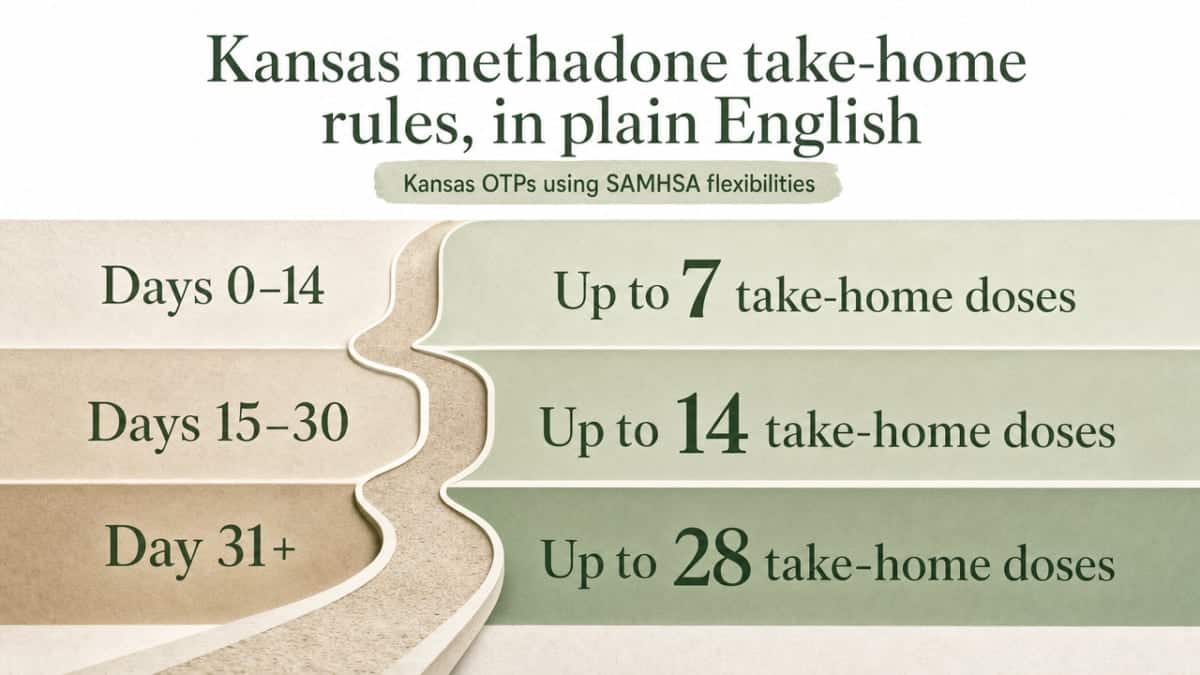
Kansas has concurred with the federal methadone take-home flexibilities SAMHSA laid out for opioid treatment programs, which means OTPs in the state can give you unsupervised doses to keep at home much sooner than the old rules allowed 9. Here’s how the timeline works.
Days 0 to 14 in treatment. Your OTP can provide up to 7 unsupervised take-home doses of methadone 9. In practice that means even in the first two weeks, you’re not necessarily locked into a daily clinic visit — your clinician has room to give you take-homes as your stability allows.
Days 15 to 30. That ceiling rises to up to 14 take-home doses 9. Two weeks of medicine at a time, if you and your care team agree you’re ready for it.
Day 31 and beyond. Up to 28 take-home doses 9. A month of medication, one clinic visit.
This isn’t automatic. Your clinician still assesses stability, safety at home, and how you’re doing before extending take-homes. But the ceiling has moved, and Kansas moved with it. If methadone has felt off the table because you can’t be at a clinic every morning, ask what a take-home schedule could actually look like for you — the answer today is different than it was five years ago.
Why trauma-informed dual diagnosis care changes the odds
Here’s a pattern a lot of people know from the inside: you get on buprenorphine, feel better, string together some weeks, and then something happens — a bad memory surfaces, a relationship blows up, sleep falls apart — and you’re back where you started. The medicine wasn’t the problem. The medicine was doing its job. What went untreated was everything underneath.
Opioid use disorder rarely travels alone. Depression, anxiety, PTSD, eating disorders, unprocessed trauma from childhood or combat or assault — these are the co-occurring conditions clinicians see over and over in the same patients. National practice guidelines are direct about this: MOUD is more effective when it’s paired with psychosocial treatment, not run as a standalone prescription 4. The medicine quiets the cravings. Therapy addresses the reasons your nervous system learned to reach for opioids in the first place.
Trauma-informed care means the clinical team assumes trauma is part of your history until proven otherwise, and builds the program around that assumption — pacing, safety, choice, and consent baked into groups and individual sessions instead of tacked on. Dual diagnosis means a psychiatrist and therapist treat the depression or PTSD alongside the opioid work, in the same building, with the same team 10. That’s what Sunflower’s 60-day residential and step-down programs are built to do. Fewer relapses at the transitions. More of the underneath, actually looked at.
Paying for treatment in Kansas: insurance, Medicaid, and what Sunflower accepts
Money is one of the first questions people ask, and it deserves a straight answer instead of a runaround.
Commercial insurance. Most private health plans in Kansas — the kind you get through an employer or the marketplace — cover opioid use disorder treatment, including MOUD, residential care, PHP, and IOP. Coverage details vary by plan: deductibles, in-network status, prior authorization for residential admissions. Sunflower Recovery Center accepts most commercial insurance and will run a verification of benefits during that first call, so you know before you commit what your plan actually pays for and what your out-of-pocket costs look like.
Kansas Medicaid (KanCare). If you’re on Medicaid, the news is good on the medication front. Kansas Medicaid’s State Plan Amendment 21-0007 confirms that MAT is covered under the state plan for all beneficiaries who meet medical necessity criteria, and Kansas covers naltrexone, buprenorphine, and methadone in all their forms 12. That means office-based buprenorphine appointments, OTP-dispensed methadone, and Vivitrol injections are within reach through Medicaid providers across the state.
No insurance at all. That’s not the end of the conversation either. Ask about self-pay options, sliding-scale providers, and Kansas OTPs that use opioid settlement or federal grant funding. A phone call clarifies more than a search bar will.
Naloxone, overdose response, and moving from rescue to treatment
Naloxone doesn’t treat opioid use disorder. It saves the life that treatment needs to work on. In Kansas, the medicine is easier to get than it used to be — pharmacies stock it, community distribution programs hand it out, and law enforcement agencies increasingly carry it under a KBI policy template that includes a discounted purchasing contract 16. If you use opioids, or love someone who does, you should have naloxone within arm’s reach. So should the people around you.
The gap that Kansas researchers keep documenting isn’t the rescue itself — it’s what happens after. A 2026 cross-sectional survey of naloxone recipients in Kansas found that common barriers to using naloxone and following up with care included limited awareness of where to obtain it and worry about stigma or legal consequences after administering it 6. In other words: people are getting revived, and then falling through a hole where the next step should be.
If you’ve been on either side of a naloxone reversal — the one who woke up, or the one who did chest compressions in a parking lot — that’s a moment when a call matters. Sunflower’s 24/7 line is one place that call can land. An OTP or an OBOT clinician is another. Rescue is the beginning, not the end.
Making the first call: what happens next
You’ve read this far. That counts.
Here’s what happens when you dial Sunflower Recovery Center’s 24/7 line. A person answers — not a menu, not a form. They ask where you are right now: using, in withdrawal, sober and scared, calling for someone else. They ask about your insurance, your medical history, any other medications you take, and whether you’ve been in treatment before. If a 60-day residential admission fits, they walk you through what arrival looks like and when a bed can open. If PHP or IOP makes more sense for your situation, they say so. If Medicaid is your coverage and you need a Kansas OTP or an OBOT clinician instead, they point you there.
You don’t have to be sure. You don’t have to have a plan. You don’t have to be sober to call. You just have to pick up the phone.
Whatever you’ve been carrying — the shame, the exhaustion, the near-misses — none of it disqualifies you from care. It’s what care is for.
Reach Out for Immediate Opioid Support Today
Speak with a caring professional ready to guide your next steps toward recovery.
Frequently Asked Questions
What medications are used to treat opioid addiction in Kansas?
Kansas providers use the same three FDA-approved medications available nationally: buprenorphine (often as Suboxone film or the monthly Sublocade injection), methadone (dispensed through SAMHSA-certified opioid treatment programs), and naltrexone (usually as the monthly Vivitrol injection) 2. All three reduce cravings and overdose risk, and clinical guidelines recommend pairing them with counseling rather than using medication alone 4.
Does Kansas Medicaid cover opioid use disorder treatment?
Yes. Kansas Medicaid’s State Plan Amendment 21-0007 confirms that medication-assisted treatment is covered for beneficiaries meeting medical necessity criteria, including all forms of buprenorphine, methadone, and naltrexone 12. One honest note: Sunflower Recovery Center does not accept Medicaid or Medicare. If Medicaid is your coverage, calling Sunflower’s line still helps — the team can point you toward Kansas OTPs and OBOT clinicians who do bill Medicaid.
How do I choose between buprenorphine and methadone?
The 2024 national guideline update treats both as co-equal first-line options, so it’s a real choice, not a hierarchy 3. Methadone tends to keep more people in treatment longer; buprenorphine tends to carry lower overdose risk after induction and can be prescribed in a regular office visit 8. Your history, other health conditions, and whether you can get to a daily clinic all matter. A clinician helps you weigh them.
How long do I have to go to a clinic every day for methadone in Kansas?
Less time than the old picture suggests. Kansas has concurred with SAMHSA’s expanded take-home flexibilities, so during your first 14 days an OTP can provide up to 7 unsupervised doses, up to 14 doses from days 15–30, and up to 28 doses after day 31 9. Your clinician still assesses stability before extending take-homes, but daily visits forever is no longer the default.
Can I start buprenorphine if I’ve been using fentanyl?
Yes, but the induction takes more care. Fentanyl lingers in body fat longer than older opioids, so the window for a safe first dose can arrive later, and precipitated withdrawal is a real risk if timing is off 7. Many patients with heavy fentanyl exposure need higher buprenorphine doses or a slower micro-dosing induction. Ask a clinician who’s done fentanyl inductions before to walk you through it.
What happens on the first call to Sunflower Recovery Center?
A person answers, any hour. They ask what’s going on right now — using, in withdrawal, sober and scared, calling for someone else — and about your insurance, medical history, and any prior treatment. If a 60-day residential admission fits, they explain arrival and bed availability. If PHP, IOP, or a Medicaid-billing provider suits your situation better, they say so. You don’t need a plan to call.
References
- Opioid Use Disorder: Treating | Overdose Prevention. https://www.cdc.gov/overdose-prevention/hcp/clinical-care/opioid-use-disorder-treating.html
- Information about Medications for Opioid Use Disorder (MOUD) (FDA). https://www.fda.gov/drugs/food-and-drug-administration-overdose-prevention-framework/information-about-medications-opioid-use-disorder-moud
- Management of opioid use disorder: 2024 update to the national clinical practice guideline. https://pmc.ncbi.nlm.nih.gov/articles/PMC11573384/
- American Society of Addiction Medicine (ASAM) National Practice Guideline for the Use of Medications in the Treatment of Addiction Involving Opioid Use. https://pmc.ncbi.nlm.nih.gov/articles/PMC4605275/
- Medications for Opioid Use Disorder Save Lives. https://www.ncbi.nlm.nih.gov/books/NBK541393/
- Understanding Outcomes and Barriers to Community Naloxone Distribution Programs: A Cross-Sectional Survey of Naloxone Recipients in Kansas. https://pubmed.ncbi.nlm.nih.gov/42137381/
- Medication for Opioid Use Disorder in the era of fentanyl: implications for treatment. https://pubmed.ncbi.nlm.nih.gov/35290179/
- Comparative Effectiveness of Buprenorphine and Methadone for Opioid Use Disorder: A Systematic Review. https://pubmed.ncbi.nlm.nih.gov/37641990/
- Methadone Take-Home Flexibility Guidance for Opioid Treatment Programs. https://www.samhsa.gov/substance-use/treatment/opioid-treatment-program/methadone-guidance
- TIP 63: Medications for Opioid Use Disorder. https://library.samhsa.gov/product/tip-63-medications-opioid-use-disorder/pep21-02-01-002
- [PDF] TIP 63: Medications for Opioid Use Disorder. https://library.samhsa.gov/sites/default/files/pep21-02-01-002.pdf
- Kansas Medicaid State Plan Amendment 21-0007 (MAT Coverage). https://www.medicaid.gov/medicaid/spa/downloads/KS-21-0007.pdf
- Federal Guidelines for Opioid Treatment Programs. https://library.samhsa.gov/sites/default/files/federal-guidelines-opioid-treatment-pep24-02-011.pdf
- Buprenorphine Training Module for Health Care Providers. https://www.cdc.gov/overdose-prevention/hcp/training-modules/buprenorphine/index.html
- Overdose Reports & Resources | Kansas Department of Health and Environment. https://www.kdhe.ks.gov/1308/Reports-Resources
- Kansas Law Enforcement Naloxone Guidance (KBI Policy Template). https://www.kdhe.ks.gov/DocumentCenter/View/12045/Law-Enforcement-PDF