
Key Takeaways
- Douglas County funds a roughly $12.5 million behavioral health system 1, giving Lawrence residents strong local access to SMART Recovery, outpatient counseling, and crisis stabilization services.
- Lawrence’s college-town environment, with heavy drinking normalized on campus and downtown 10, creates geographic and social triggers that make outpatient-only recovery harder to sustain.
- Local care through Bert Nash, DCCCA, Heartland, and the Treatment & Recovery Center covers outpatient and crisis needs, but structured residential dual diagnosis treatment typically means driving about 50 minutes south to Osawatomie.
- Before deciding, compare level of care, length, insurance fit, and environment: KanCare covers the full continuum 8, while commercial plans open more residential options including Sunflower.
What Recovery Looks Like From Douglas County
If you’re reading this in a parked car off Massachusetts Street, or at your kitchen table in East Lawrence at 2 a.m., or on your phone in a Watson Library carrel between classes — that took something. Whatever brought you here, you already know something has to change.
Here’s what’s true about getting sober from Lawrence: the local safety net is real. Douglas County voters funded a behavioral health system that now runs on roughly $12.5 million annually, supporting crisis stabilization, medication-assisted detox, and community treatment 1. You have SMART Recovery groups meeting at the public library twice a week, a daily support line, and campus-linked services through KU’s Cofrin Logan Center 2. That’s more than most Kansas towns can say.
But Lawrence’s system was built for crisis response and outpatient care. When your situation calls for a structured 60-day residential program with trauma-informed dual diagnosis treatment, you’ll likely leave town for it. The good news is that “leaving town” often means a 50-minute drive south to Osawatomie — closer than Kansas City, closer than most people assume. This guide walks you through what’s here, what’s not, and how to decide.
Getting Sober in a College Town Is Its Own Problem
Let’s name the thing. Lawrence is a beautiful town to live in and a hard town to get sober in. Massachusetts Street is essentially a linear bar crawl. Football Saturdays reorganize the city’s social calendar around drinking. Your friends’ text threads are about which patio, which pitcher, which afterparty. If your relationship with alcohol or drugs has crossed a line, that environment isn’t neutral background — it’s a daily challenge.
The numbers back up what you already feel. In KU’s 2024 U Celebrate survey, 63.2% of respondents were classified as drinkers, 17.2% as heavy drinkers, and the average was 4.35 drinks per drinking day 10. That’s a campus where heavy drinking is common enough to blend in. It’s easy to convince yourself your use is normal because, statistically, in this zip code, it kind of is. That’s the trap. “Normal for Lawrence” and “safe for you” are not the same thing.
And it isn’t only students. If you graduated five, ten, twenty years ago and stayed in town, you inherited the same social geography. The bars where you used to close out your twenties are the bars your coworkers still meet at on Thursdays. The kratom shop is on your walk home. The dispensary run to Missouri is a routine errand. Kansas as a whole carries the weight too — SAMHSA estimated about 141,000 Kansans aged 12 and older had an alcohol use disorder in a recent multi-year average, roughly 6% of that population 6. You are not an outlier. You are one of many people trying to figure this out.
Here’s what the college-town texture actually means for your recovery, practically:
- Your triggers are geographic. The Hill, the Wheel, the tailgate lot — these are places, not abstractions. Any real plan has to account for them.
- Your social identity may be entangled with drinking. Cutting back isn’t just a health decision; it’s a friendship decision, and that’s harder to say out loud.
- The semester rhythm creates cycles. Finals week, spring break, Homecoming — each one has been a reason before. They’ll be reasons again unless something changes.
- Access is easy. Delivery apps, late hours, a walkable downtown. What’s convenient for a night out is convenient for a relapse.
None of this means you can’t get sober in Lawrence. People do, every day. It does mean that white-knuckling it while surrounded by the same cues probably isn’t the plan. Sometimes the most useful thing you can do is put physical distance between yourself and the environment for long enough to rebuild — which is part of why residential care, even an hour away, works when local options haven’t.
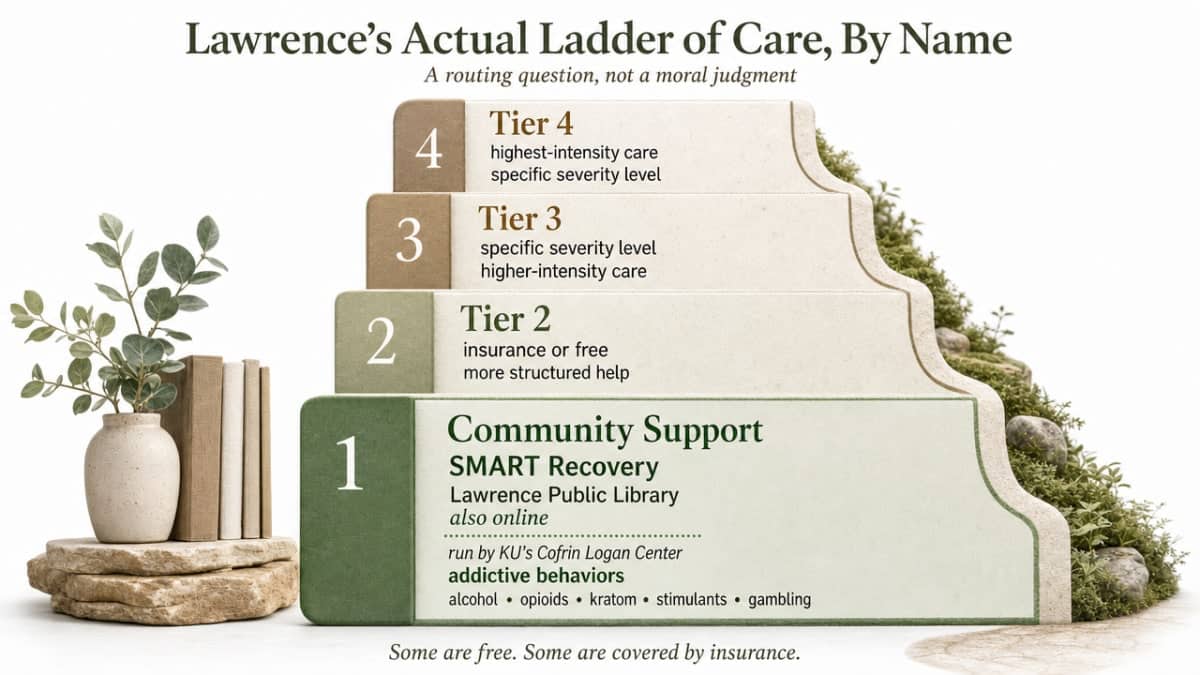
Lawrence’s Actual Ladder of Care, By Name
One of the most frustrating things about looking for help in Lawrence is that people keep telling you to “reach out” without telling you who to reach out to. So here it is, plainly: the local system has four rough tiers, and you deserve to know what each one actually does. Some are free, some are covered by insurance, and some are only useful at a specific level of severity. Knowing where you fit isn’t a moral judgment. It’s a routing question.
Community Support: SMART Recovery at the Public Library
If the idea of walking into a treatment facility feels like too much right now, start smaller. KU’s Cofrin Logan Center runs SMART Recovery groups twice a week — one in person at the Lawrence Public Library downtown, one online — and the groups welcome anyone dealing with addictive behaviors, whether that’s alcohol, opioids, kratom, stimulants, gambling, or something else you haven’t said out loud yet 2. You don’t need a referral. You don’t need insurance. You don’t need to identify as anything at the door.
The center also runs a SMARTline from 4 to 8 p.m. daily, which is a real person on the other end of the phone when the evening hits and you’re not sure what to do with yourself 2.
Here’s the honest framing: SMART Recovery is a support tool, not a treatment plan. If you’re drinking a fifth a day, if you’re using fentanyl, if you’re in acute withdrawal — a library meeting is not going to be enough on its own. But if you’re in the earlier part of admitting something’s wrong, or you’re stepping down from more intensive care and need a weekly anchor, this is a good, low-stakes place to put your feet.
Outpatient Care: Bert Nash, DCCCA, and Heartland
The next rung up is outpatient care, and Lawrence has three names worth knowing.
Bert Nash Community Mental Health Center is the county’s primary community mental health center and handles a lot of the front-door work for people whose substance use is tangled up with depression, anxiety, or trauma. Because Bert Nash is county-connected, they’re often the referral point when someone shows up in crisis and needs ongoing therapy after stabilization.
DCCCA is the local name for outpatient substance use treatment specifically — assessments, individual counseling, group work, and connections to the drug court system when the legal side is part of the story. If you’ve been told you need a formal SUD evaluation, whether for a court case, a job, or your own peace of mind, DCCCA is typically where that happens in Douglas County.
Heartland Community Health Center is the federally qualified health center on the west side, and matters here because primary care is often where the addiction conversation actually starts. Your Heartland provider can prescribe buprenorphine, screen for co-occurring conditions, and coordinate with counseling — helpful if you don’t want your first step to be walking into anything labeled “rehab.”
Outpatient works when you’re stable enough to sleep at home, hold down your responsibilities, and not use between sessions. Statewide, about 72.4% of Kansas treatment facilities offer trauma-related counseling and 90% offer group counseling, so the outpatient tier is where most Kansans in treatment actually spend their time 5. If that’s you, great. If it’s not, keep reading.
Crisis Stabilization and Detox: The Treatment & Recovery Center
When outpatient isn’t enough — when you can’t stop on your own, when withdrawal is medically serious, when you’re one bad night away from something worse — Douglas County built the Treatment & Recovery Center for exactly this moment.
This is the piece of the local system Lawrence voters funded on purpose. The county’s behavioral health sales tax generates about $4.9 million a year, and combined with property tax revenue supports a behavioral health fund of roughly $12.5 million annually — money that pays for the recovery campus, crisis stabilization, medication-assisted detox, supportive housing, and prevention programs 1. That’s a bigger local commitment than most Kansas counties have made, and it means walking into crisis care here isn’t a favor being done for you. It’s a service your neighbors chose to fund.
Under Kansas regulation, crisis intervention centers are built to stabilize you, treat acute withdrawal, and connect you to the next level of care, working from ASAM 3.7 or 4.0 clinical criteria 7. In plain English: they can medically manage you through the first hard days safely, and they’re required to help you figure out what comes next.
When Local Support Is No Longer Enough
There’s a specific moment most people can point to later — the one where they realized outpatient wasn’t going to hold. Maybe you kept the therapy appointments and drank between them. Maybe you swapped one substance for another and told yourself it counted as progress. Maybe you went to a SMART Recovery meeting on Tuesday and were high by Friday. That gap between showing up and staying stopped is where residential care starts to make sense.
Here are the honest signals, and if two or more sound like you, it’s time to consider stepping up:
- You’ve tried outpatient in Lawrence — Bert Nash, DCCCA, a counselor, a group — and you’re still using at roughly the same rate, or worse.
- Your withdrawal is medically serious. Shakes, seizures, benzodiazepine or alcohol dependence, opioid dependence with fentanyl involved. This is not a “tough it out” situation.
- Your home environment is part of the problem. A roommate who uses, a partner who drinks with you, a house where the substance is always within reach.
- Something underneath the addiction — trauma, an eating disorder, untreated depression — keeps pulling you back the moment life gets hard.
- You’ve overdosed, blacked out somewhere unsafe, or scared someone who loves you.
That last one matters more than it feels like it should. Kansas drug poisoning deaths rose 68% from 2016 to 2020, driven largely by synthetic opioids like fentanyl 4. The math on “one more time” isn’t what it used to be. Pills bought off a friend of a friend aren’t what they used to be either. If your use has drifted anywhere near opioids or unknown powders, the window between outpatient-appropriate and residential-appropriate can close faster than you’d expect.
None of this is meant to scare you into a decision. It’s meant to give you permission. If Lawrence’s outpatient tier has been an honest try and it hasn’t been enough, that isn’t a failure on your part. It’s information. The next step is a program that can hold you for longer than a session — somewhere the environment itself is part of the treatment.
Residential Care and the Drive South to Osawatomie
What a 50-Minute Drive Actually Looks Like
Here’s the part people build up in their heads until it feels impossible. You picture being shipped somewhere. You picture a compound in the middle of nowhere. You picture explaining to your boss, your kids, your dog-sitter why you’ll be unreachable.
The actual geography is smaller than that. Osawatomie sits about 50 minutes south of Lawrence — US-59 south through Ottawa, then east on K-68. It’s a familiar drive for anyone who’s taken a Sunday to see the Flint Hills. On a Tuesday morning with no traffic, you’ll be there before your coffee gets cold.
Who drives you matters more than the map. Most people are brought by a partner, a parent, a sibling, or a friend who knows. If you don’t have that person, Sunflower’s admissions team can talk through options — a ride from a family member in another town, a car service, or an early-morning pickup. Pack light. A week of clothes, comfortable shoes, prescription bottles in their original containers, a photo or two, a book. You will not need most of what you’d bring on a vacation.
The drive is not a punishment. It’s the border between the environment that’s been feeding this and the space where something else becomes possible.
Trauma-Informed Dual Diagnosis: A Narrower Slice of Kansas Treatment
Not every Kansas treatment program does what you need. That’s worth saying out loud, because “there are lots of options” can be its own kind of misdirection when the options don’t fit.
Kansas had 170 SUD treatment facilities as of the last full state census, and while 72.4% offered some form of trauma-related counseling, nearly half — 47.6% — offered no pharmacotherapy services at all 5. That’s the narrowing. When you overlay “residential level of care” with “trauma-informed” with “able to actually treat co-occurring depression, anxiety, PTSD, or an eating disorder alongside the addiction,” the number of programs that check every box gets small fast.
Why does this matter for you? Because the reason outpatient in Lawrence didn’t hold may not be that you didn’t try. It may be that the trauma underneath — the thing you drink at, or use at, or eat at — never got treated. A program that only addresses the substance, without ever asking what the substance was doing for you, tends to leave a person primed for relapse the moment life gets loud again.
Sunflower’s 60-day residential program is built around exactly that overlap: substance use, trauma, and co-occurring mental health conditions treated as one integrated picture rather than three separate problems handed off between departments. Family programming, biometric tracking of sleep and stress patterns, and a discharge plan that starts on day one are part of the same continuum. If your last attempt at care felt like it only scratched the surface, that’s the gap this level of program is designed to close.
Comparing Your Options: Lawrence vs. Osawatomie
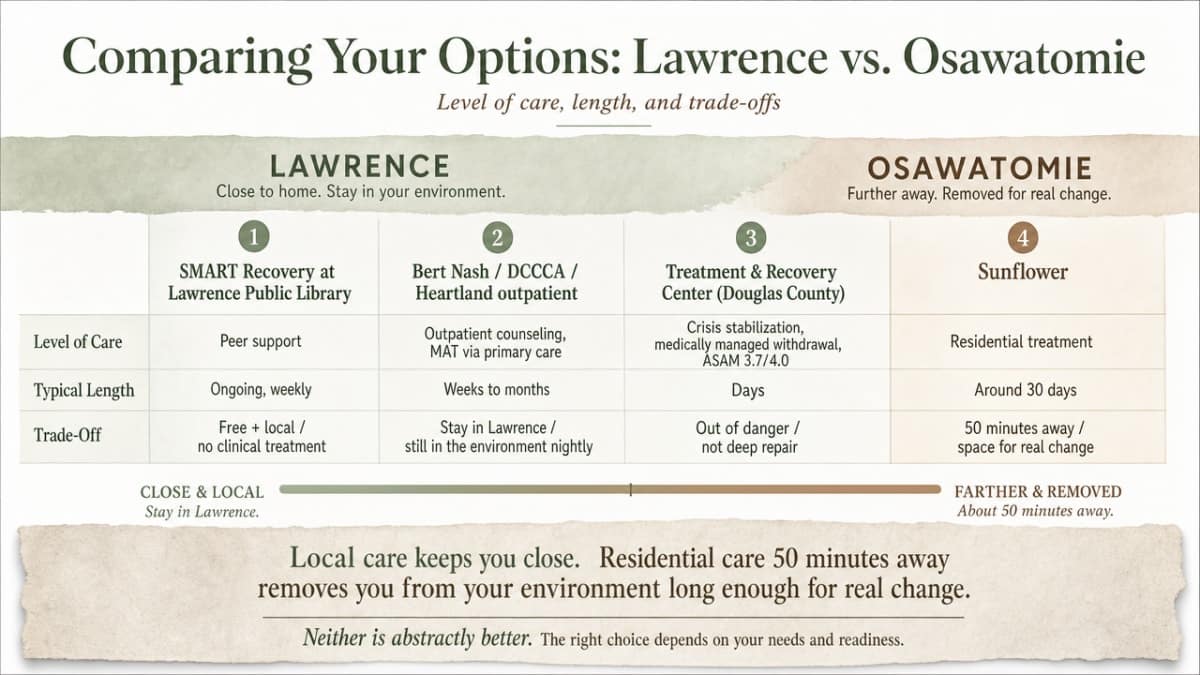
It helps to see the trade-offs side by side. Local care keeps you close to work, school, and family. Residential care 50 minutes away removes you from your environment long enough for real change. Neither is better in the abstract. What matters is which one fits where you actually are.
| Option | Level of Care | Typical Length | You’re Trading Off ||—|—|—|—|| SMART Recovery at Lawrence Public Library | Peer support | Ongoing, weekly 2| Free and local, but no clinical treatment || Bert Nash / DCCCA / Heartland outpatient | Outpatient counseling, MAT via primary care | Weeks to months | Stay in Lawrence, but you’re still in the environment nightly || Treatment & Recovery Center (Douglas County) | Crisis stabilization, medically managed withdrawal, ASAM 3.7/4.0 7| Days | Gets you out of danger, not deep repair || Sunflower Recovery Center (Osawatomie) | Residential dual diagnosis, PHP, IOP | 60 days residential, then step-down | ~50-minute drive; away from Lawrence during treatment |
A few honest notes on how to read this. If SMART Recovery on Tuesday nights and a Bert Nash counselor every other week are enough to keep you stable and not using, that is real recovery, and you should keep going. If they aren’t — if you’ve been running that plan and still ending up where you don’t want to be — the next honest step is a program with enough time and distance to actually do the work.
The Treatment & Recovery Center handles the emergency. Residential care handles what happens next. They aren’t competing options; they’re consecutive ones. Most people who end up at Sunflower didn’t skip the local rungs — they climbed them first, and then needed more.
Paying for Treatment: KanCare, Private Insurance, and the Gaps
The money question is usually the one that keeps people frozen. So let’s take it head-on.
If you have KanCare (Kansas Medicaid), the good news is that the program covers the full continuum of SUD care — outpatient, intensive outpatient, MAT, withdrawal management, and residential treatment — and residential facilities are required to provide access to medication-assisted treatment 8. On paper, that’s broad coverage. In practice, network adequacy has been a real issue. An independent federal assessment found that intensive outpatient and residential service use under KanCare was significantly lower in 2020 than in 2019, and rated MAT capacity and care coordination as ongoing medium-to-high risk areas 3. Translation: coverage exists, but finding a KanCare-participating residential bed when you need one isn’t always quick.
Sunflower does not participate in Medicare or Medicaid. If KanCare is your coverage, Bert Nash, DCCCA, and the Treatment & Recovery Center are your in-network anchors for outpatient and crisis care, and the state’s KanCare-contracted residential programs handle inpatient-level treatment.
If you have commercial insurance through work, a spouse, or a KU employee plan, Sunflower accepts most major carriers. The honest next step is a five-minute call to verify your specific plan, deductible status, and what residential days look like against your out-of-pocket maximum. Bring the member ID number when you call. That single conversation usually turns “I can’t afford this” into a real number you can plan around — and often a smaller one than you feared.
Cost is a barrier worth naming out loud. It is not a reason to stop asking.
Making the Call: A Practical Script for the Next 24 Hours
Reading about treatment and actually picking up the phone are two different acts, and the second one is the hard one. So here’s what the next 24 hours can look like, broken down small enough to be doable.
- Right now, tonight: tell one person. A sibling, a parent, a friend who’s asked before and meant it. You don’t need a speech. “I think I need help and I’m looking into it” is a full sentence. Saying it out loud to another human being changes something you can’t get from reading alone.
- Before you go to sleep: find your insurance card and write down the member ID. If you have KanCare, Bert Nash and the Treatment & Recovery Center are your closest starting points 8. If you have commercial insurance through work, KU, or a family plan, you have more options, including Sunflower.
- Tomorrow morning: make one call. If you’re in acute crisis or withdrawal, that call is to the Treatment & Recovery Center. If you’ve already tried outpatient in Lawrence and you’re ready to ask what residential looks like, call Sunflower and ask the specific questions you actually have. What does the drive from Lawrence look like on admission day? Who can drive me? What do I pack? How do family visits work during 60 days? Will my insurance cover it, and what’s my share?
You are not committing to anything by asking. You’re gathering information. The admissions conversation is a phone call, not a contract.
One more thing worth saying. If you called and didn’t follow through last month, or last year, that’s not a mark against you. Most people who end up in treatment made this call more than once before it stuck. Making it today counts. Making it again tomorrow counts. The only version of this that doesn’t work is the one where you stop asking.
Talk With a Local Expert About Your Next Step
Get clear answers on starting trauma-informed addiction care from Lawrence or the KU community.
Frequently Asked Questions
What addiction treatment options are actually available in Lawrence, KS?
Lawrence has a four-tier system: SMART Recovery peer groups through KU’s Cofrin Logan Center at the public library 2, outpatient counseling and MAT through Bert Nash, DCCCA, and Heartland Community Health, crisis stabilization and medically managed withdrawal at Douglas County’s Treatment & Recovery Center 1, and residential dual diagnosis care available at facilities outside the county, including Sunflower Recovery Center about 50 minutes south in Osawatomie.
How far is Osawatomie from Lawrence, and how do people get there for residential treatment?
Osawatomie sits roughly 50 minutes south of Lawrence, mostly on US-59 through Ottawa and then east on K-68. Most people are driven by a partner, parent, sibling, or close friend on admission day. If you don’t have that person available, Sunflower’s admissions team can help talk through options like a family member from another town or a car service. You bring a week of clothes, medications, and comfortable shoes.
How do I know when outpatient care in Lawrence isn’t enough and I need residential treatment?
The clearest signals are these: you’ve genuinely tried outpatient and you’re still using, your withdrawal is medically serious, your home environment keeps pulling you back in, or something underneath the addiction — trauma, depression, disordered eating — never got treated. If your use involves opioids or unknown powders, the stakes have shifted; Kansas drug poisoning deaths rose 68% from 2016 to 2020 4. Two or more signals mean it’s time.
Does KanCare or private insurance cover residential addiction treatment for Lawrence residents?
KanCare covers the full continuum, including residential treatment, and requires residential facilities to provide access to MAT 8. Sunflower does not participate in Medicaid or Medicare, so KanCare members typically use state-contracted residential programs, with Bert Nash and the Treatment & Recovery Center as in-network anchors locally. Sunflower accepts most commercial plans. A five-minute call with your member ID turns coverage from a fear into a real number.
I’m a KU student. Can I get help without derailing my semester?
Yes, though the honest answer depends on where you are. Cofrin Logan Center offers KU-linked clinical services and SMART Recovery groups that fit around class schedules 2. If you need residential care, most universities have medical withdrawal and re-enrollment processes for exactly this situation — treatment counts as a health matter, not an academic one. Talk to the dean of students office. Stepping away for 60 days is not the end of your degree.
What happens with family visits and staying connected during a 60-day residential stay?
Residential care isn’t isolation. Sunflower includes family programming as a core part of treatment, and the 50-minute drive from Lawrence makes weekend visits genuinely doable — closer than most family members expect when they first hear the word “residential.” Structured phone contact, family therapy sessions, and education for the people who love you are built into the program. Ask specifically about the visit schedule when you call admissions.
References
- Improving Behavioral Health in Douglas County: Before you vote, be informed. https://www.dgcoks.gov/sites/default/files/media/pdf/behavioral-health-flyer-color.pdf
- Community Services & Partnerships – Cofrin Logan Center for Addiction Research and Treatment. https://addiction.ku.edu/community-services-partnerships
- Mid-Point Assessment of the KanCare 2.0 Section 1115 Substance Use Disorder Demonstration. https://www.medicaid.gov/medicaid/section-1115-demonstrations/downloads/ks-kancare-sud-mid-pnt-asesmnt.pdf
- 2022–2027 Kansas Overdose Prevention Strategic Plan. https://www.kdhe.ks.gov/DocumentCenter/View/5018/2022-2027-Kansas-Overdose-Prevention-Strategic-Plan-PDF
- 2020 State Profile — Kansas (National Survey of Substance Abuse Treatment Services). https://www.samhsa.gov/data/sites/default/files/quick_statistics/state_profiles/NSSATS-KS20.pdf
- Behavioral Health Barometer: Kansas, Volume 4. https://www.samhsa.gov/data/sites/default/files/Kansas_BHBarometer_Volume_4.pdf
- Kan. Admin. Regs. § 26-52-17 – Alcohol and substance abuse services. https://www.law.cornell.edu/regulations/kansas/K-A-R-26-52-17
- KanCare 2.0 SUD and OUD Interim Evaluation Report. https://www.medicaid.gov/medicaid/section-1115-demonstrations/downloads/ks-kancare-appvd-int-eval-rpt-sud-01042023.pdf
- University of Kansas Drug-Free Schools and Communities Act Biennial Review Report 2024. https://civilrights.ku.edu/sites/civilrights/files/images/Reports/Final%20KU%20DFSCA%20BRR%202024.pdf
- University of Kansas Biennial Review Report 2025. https://civilrights.ku.edu/sites/civilrights/files/2025-12/University%20of%20Kansas%20Biennial%20Review%20Report%202025.pdf
- Alcohol Use of University of Kansas Students: 1992 Survey. https://files.eric.ed.gov/fulltext/ED352575.pdf